• Blog
  • Shop
  • Podcast
  • Resources
  • About
  • Archive
  • Contact
  • Cart
  • Sign In My Account
Menu

The Gentleman Stationer

Vintage Living in the Modern World.
  • Blog
  • Shop
  • Podcast
  • Resources
  • About
  • Archive
  • Contact
  • Cart
  • Sign In My Account

Ask TGS: Where Do I Start with Paper for Notebook Systems?

May 11, 2024

I'm regularly asked: "How do I get started?" The sheer number of different brands of paper and notebooks now available on the market can be overwhelming to those new to the world of high-end and imported stationery. Lately, it's become one of the more common questions I receive, especially at pen shows from those interested in building out a planner or notebook system but not knowing where to begin.

Any paper recommendation depends heavily on intended use, but in my experience most new users (and most everyday writers in general) are looking for a versatile, multi-purpose paper that they can use with a fairly broad range of writing instruments and, in the case of fountain pens, different inks. Most people want the ability to use their notebooks both at work and for fun. Given that, I try to direct people to paper that balances "ink-friendliness" with reasonable dry times. There are plenty of paper options out there that fall into this category, and which are relatively inexpensive to boot, so it shouldn't be cost-prohibitive to experiment with a few different brands and find the paper that works best for you.

The Lochby Field Journal can hold up to six slim A5 notebooks, or two thicker A5 notebooks. It’s a universal A5 size allows you to use different notebooks from all sorts of different brands, in an seemingly endless universe of layouts.

A Note on How These Recommendations are Set Up

Given my personal focus on notebook systems and covers, I typically get this question from people looking for refills for their new system binder from Lochby, Roterfaden, or another similar company. The recommendations below are therefore framed in terms of slim A5 notebooks. However, the same considerations apply to people looking to try good paper in general, and all of the companies listed below make their paper in a wide range of sizes and formats, including spiral notebooks and pads. And even with notebook systems, you’re not limited to the slim A5 notebooks (as shown in the picture above). You just won’t be able to carry as many at once.

  • Midori MD Paper: I usually recommend that people start here, in either the standard MD notebooks or the three-packs of slimmer MD Light notebooks. (I can't tell a difference between the paper and I think it's the same.) For those who want to carry multiple inserts in a cover system, the MD Light notebooks will work best, but if you want to stick with one or two thicker notebooks, then go with the standard MD notebook. The reason why I love Midori paper, especially for those looking to test out good paper for the first time, is because the paper is somewhat absorbent and strikes a good balance between ink-friendliness and dry times.

  • Nakabayashi Logical Prime Threadbound Notebooks. I discovered Nakabayashi paper last year, and it's proven extremely popular due to the fact that it's very fountain pen friendly, ink dries quickly, and the unique multi-lined ruling is reminiscent of Clairefontaine French-ruled paper without the longer Clairefontaine dry times. The slim A5 threadbound notebooks are most popular for the various "system covers", but there are other formats in different sizes. All of the various types of paper handle fountain pen ink well, including the lighter Logical Air and the heavier Yu-sari.

  • Lochby Tomoe River 68gsm Notebooks. I have always preferred the heavier, slightly more absorbent 68gsm Tomoe River paper over the lighter 52gsm version, at least for everyday use. I've found that it has a faster dry time, and also resists tearing and wrinkling, making it a preferred choice for the office. That said, I've not been able to find much information on the future of this paper. Tomoe River Paper is now being manufactured by a new company, and while Lochby still has stock of the 68gsm paper, I suspect it will eventually be phased out given that it's (unfairly, IMHO) less popular than its lightweight counterpart. Lochby does have some interesting ruling options in this format, including Wide Ruled and Undated Planner layouts, which you can't easily find elsewhere.

But What About the Traveler's Company Traveler's Notebook?

The Traveler's Notebook system is a bit of a different animal because it’s a proprietary size. While there are non-Traveler's branded refills out there in different papers, most of the "official" refills use some version of Midori MD Paper (most of the standard refills) or 52gsm Tomoe River (Lightweight Paper). I usually recommend that people interested in the Traveler’s Notebook start with the standard MD Paper refills (one blank refill is included with your cover) and then switch to the Lightweight Paper or Sketch or Watercolor Papers if they need something different.

All of these recommendations are just a starting point. As I mentioned up top, once you find a core paper that works for most of your everyday writing, you can experiment and start trying different specialty papers and other brands. My favorite aspect of a multi-refill notebook cover (a "notebook system") is the ability to carry many different papers at once and switch back and forth as you go. (The next thing you know, you're a nut like me, with three different systems in rotation all at once, because you know you need to use all the papers!)

For further reading, be sure to check out our guide to fountain pen friendly papers, which has an active comments section in addition to the papers I’ve personally tried.

The Gentleman Stationer is supported entirely by purchases from the T.G.S. Curated Shop and pledges via the T.G.S. Patreon Program. If you enjoy our content, we greatly appreciate your support!
In Ask TGS Tags Fountain Pen Friendly Paper, Notebook Systems, Editorial, Ask TGS
3 Comments
Craighill Caro Pen and Victorinox Swiss Army Knife Side by Side

Ask TGS: "Emergency Pens" and Paper Sizes A4 vs. Legal

February 14, 2024

The questions keep coming! It turns out that I really enjoy writing these posts because they’re directly responsive to things that readers want to know. I’ve also received a lot of feedback that you all find the Q&A format helpful, so I’m going to continue to prioritize this type of writing and make this part of the regular rotation.

Question 1: Do You Carry an “Emergency Pen” That Is On Your Person At All Time?

I found this question interesting because (1) it’s somewhat offbeat/unusual and (2) I’ve curiously been asked about this topic several times in the past few months. First of all, by “emergency pen,” I believe people are referring to a very small compact pen that you keep on your person as a “last-resort” writing instrument for when you absolutely need something to sign a document, make an urgent note, etc. It doesn’t need to be comfortable to use for longer writing sessions. The key attributes here are portability, reliability - especially if it sits unused for a longer period of time - and unobtrusiveness. It’s almost always going to be some sort of ballpoint.

Craighill Caro in-Hand

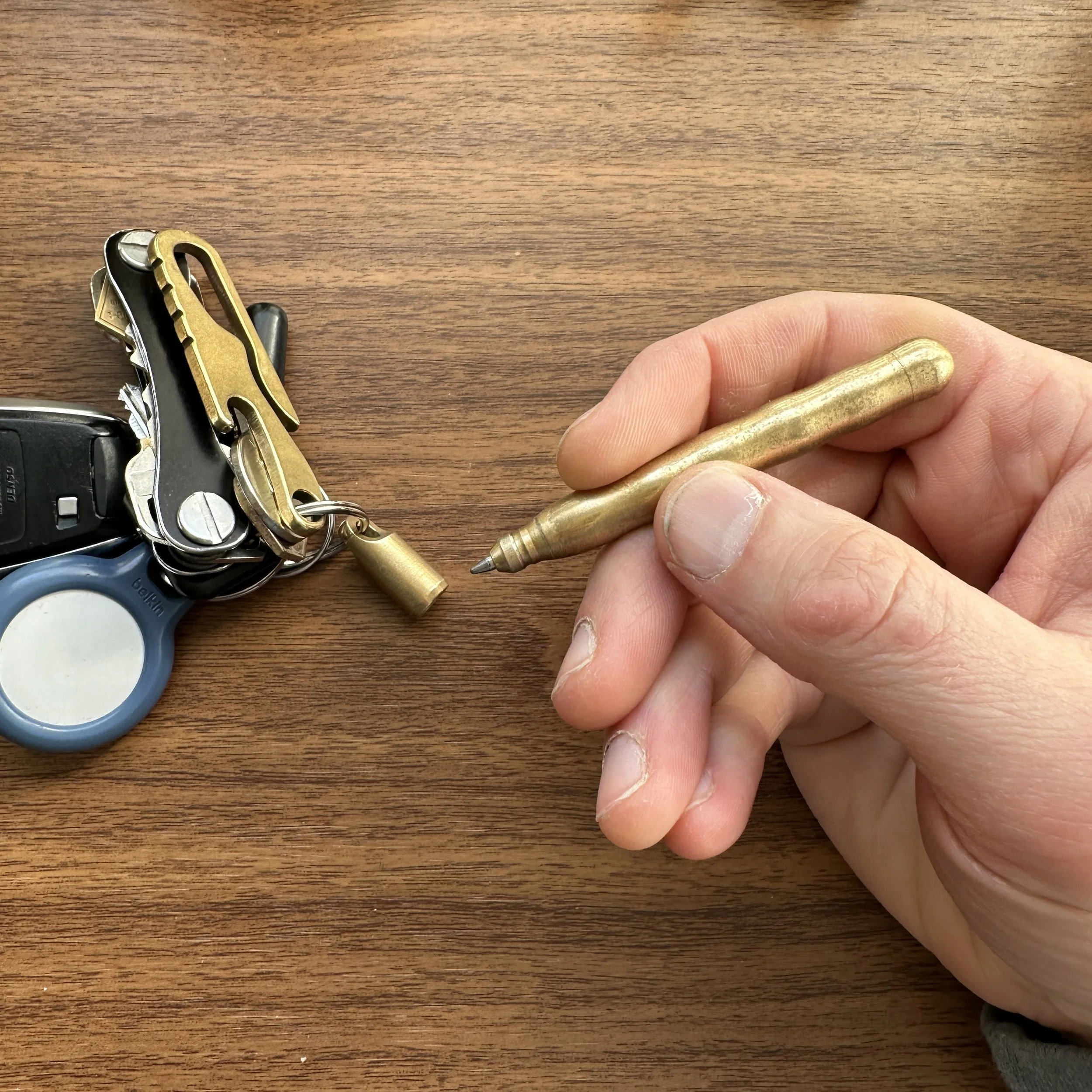
My current “anywhere and everywhere” choice: the Craighill Caro Pen.

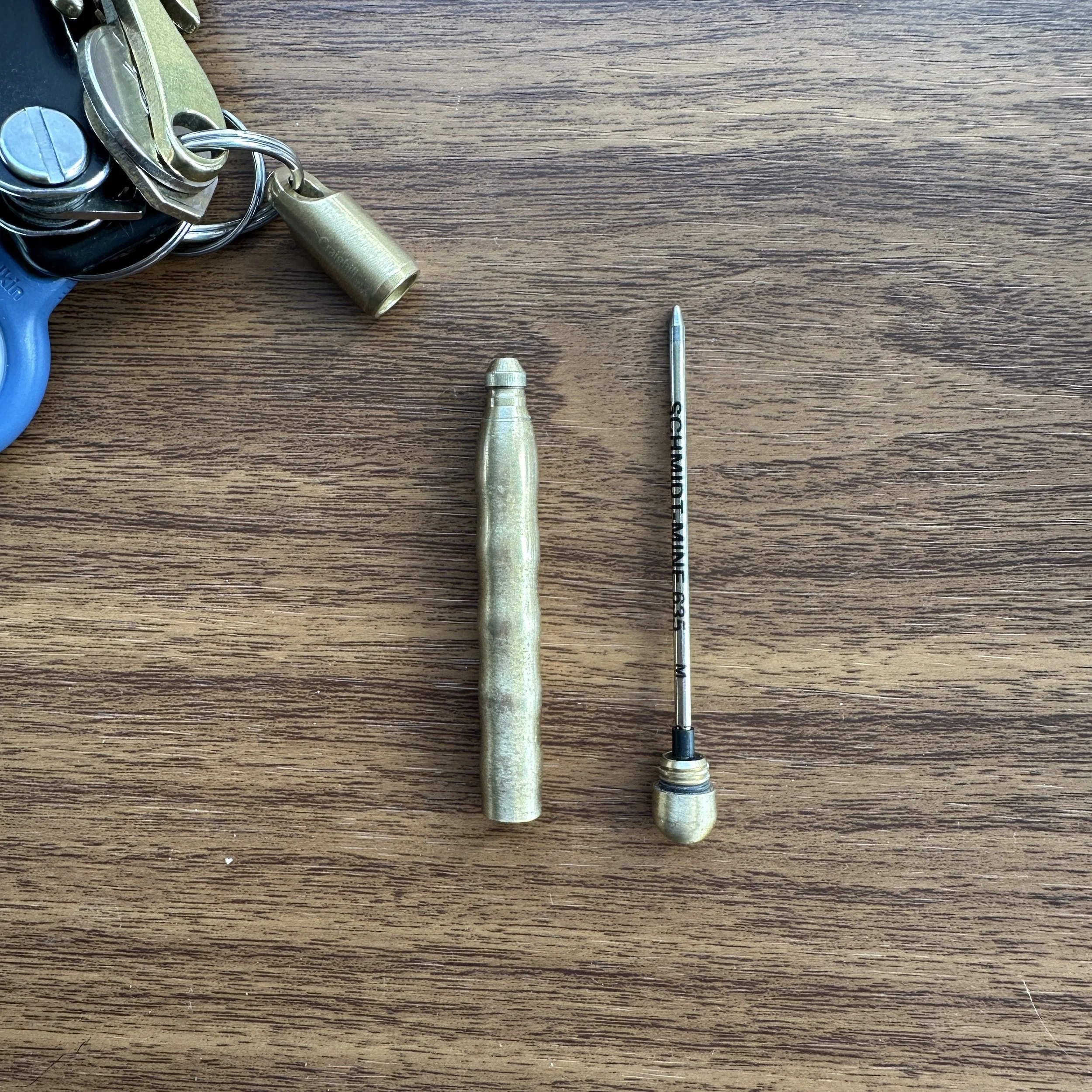
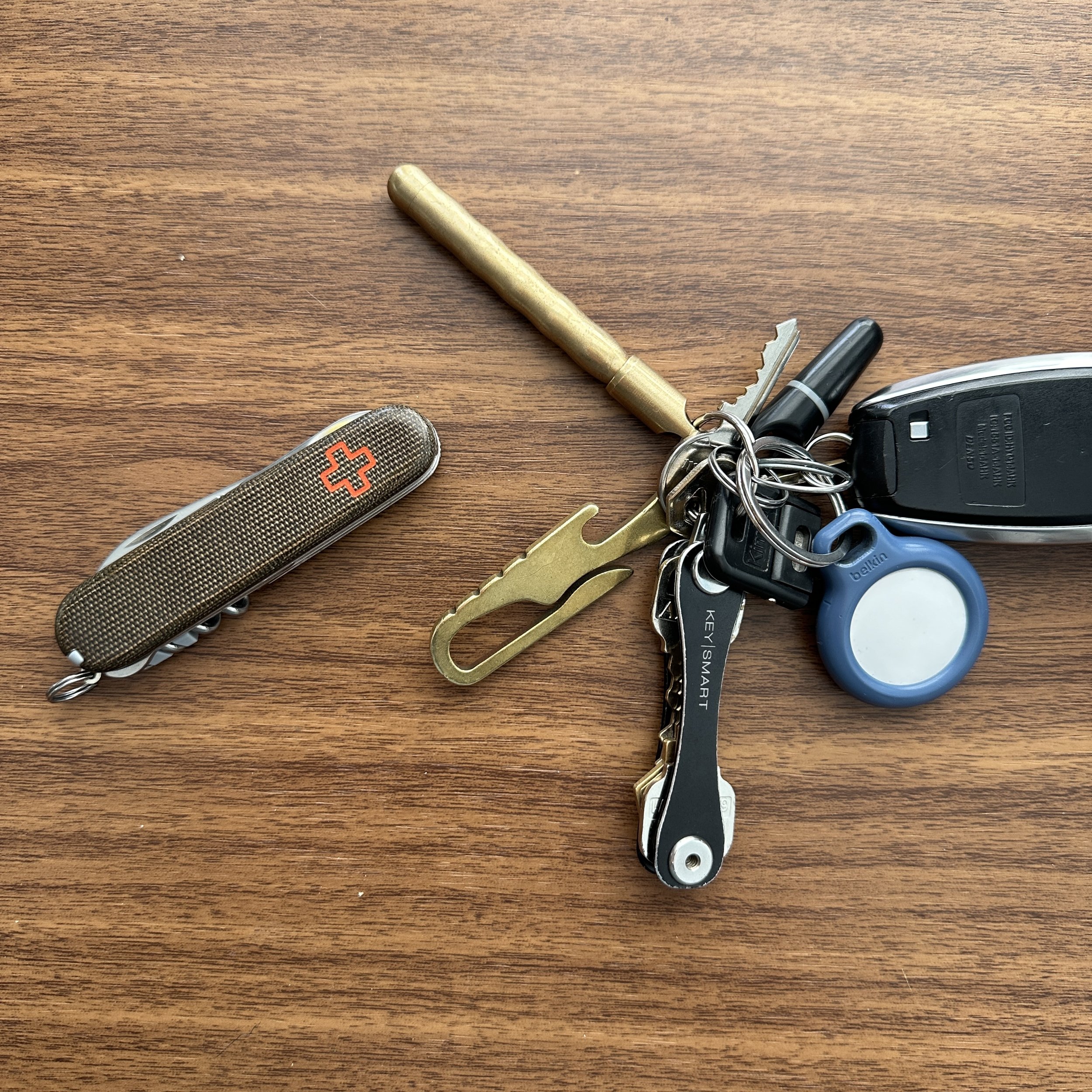
To answer this question directly: yes. For many years I carried a “Wallet Pen”, which was basically a modified D1 refill with a clip attached to it, designed to sit in the middle of a bifold wallet. I lost track of this pen long ago (it’s probably still around here somewhere), but because I’ve moved on from larger wallets to slimmer card sleeves, it would no longer meet my needs. Currently, I have two options that I usually carry as a contingency. I keep a Craighill “Caro” pen attached to my keychain, and I’ve been incredibly impressed with this simple tool that was originally recommended to me by a reader. Like the Wallet Pen, the Caro takes a D1 refill and clips to your keychain using a dock attachment that functions as a cap. The cap uses a garter spring to ensure a secure fit - I’ve been carrying this pen for four or five months now, mostly in my pocket, and I’ve not had it come loose once. After the Caro, I would probably rely on the D1 refill in my Victorinox Swiss Army knife as a true “last resort” option.

View fullsize Craighill Caro Pen + Refill
Craighill Caro Pen + Refill
View fullsize Craighill Caro Pen + Victorinox "Pen"
Craighill Caro Pen + Victorinox "Pen"

Question 2: Will US Legal-Size Writing Pads Fit An A4 Portfolio?

One of the more vexing paper sizes for those of us who love stationery products - especially imported bags and cases - is the U.S. Legal Pad. It’s a “size” typically unique to the U.S., but there’s no uniformity - throughout my career as a practicing attorney, I’ve seen products marketed as “legal pads” that measure any where from 8.5” x 11.75” to 8.5” x 14”. While the extremely long 14” version is not nearly as common as it used to be (even in the legal profession), you still have to be careful because legal pads will not fit A4 or Letter-sized portfolios once you go past 12” in length. For example:

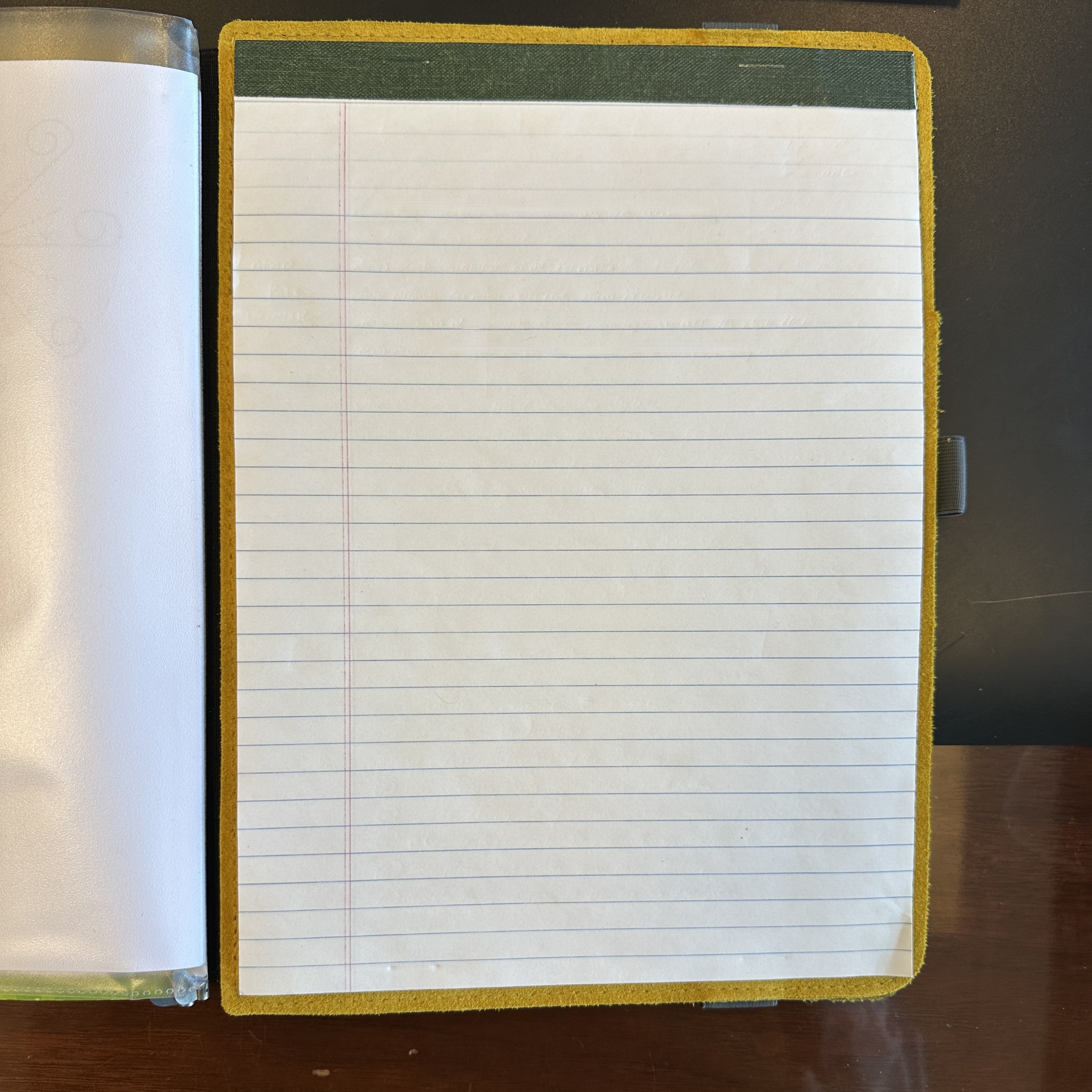
Legal Pad in A4 Portfolio

Show here is an 8.5” x 11.75” Roaring Springs Legal Pad in an A4 Roterfaden Taschenbegleiter notebook cover. This fits quite well, but there’s no room left for a longer pad.

The pad shown in the picture above is an 8.5” x 11.75” Roaring Springs Legal Pad, which is roughly the same size as a traditional 8.3” x 11.7” A4 writing pad. This particular “legal pad” should fit most A4 portfolios and padholders, but again, pay attention to your specific dimensions when you are ordering. For additional information on how different paper sizes compare, you can check out this rough “guide” to paper sizing from a few years ago.

Ask TGS in Person: Visit us at the California Pen Show This Weekend!

Tomorrow morning I’m leaving bright and early for the 2024 California Pen Show, where I will be holding a discussion/class/seminar on “Stationery for Everyday Writing,” and I hope to keep most of the focus on questions such as the ones addressed here, as well as in other recent “Ask TGS” Posts on topics such as how to avoid staining your pens, how to get the best writing experience with specialized inks (like shimmer inks), and the best paper for written correspondence (personal or professional). I hope to see you there!

The Gentleman Stationer is supported by purchases from the T.G.S. Curated Shop and pledges from the T.G.S. Patreon Program.

In EDC, Ask TGS Tags Ask TGS, Pocket Pen, Emergency Pen, EDC
4 Comments

If you run into any problems with a fountain pen, your first order of business should be to clean it. That solves 80% of issues, including most skipping and hard-starting.

Ask TGS: Common Questions on Fountain Pens, including Hard Starting Pens and Staining Inks

January 31, 2024

Welcome back to another installment of “Ask TGS”! I get a LOT of mail, whether it’s e-mail, snail mail, or social media DMs, and unfortunately there’s no way I can respond to it all. I’m therefore trying to devote at least one post per month to answering the more frequently asked questions, and eventually plan to compile these posts into a FAQ resource. This week’s selection of questions focuses on fountain pens and common performance issues, including skipping/hard-starting and - gasp - the possibility of ink staining the pen.

Question 1: I recently purchased my first fountain pen and inked it up out of the box. The pen tends to skip and hard start. Is this normal for a new Pen?

I get this question in the mailbag a few times each year. While it’s never “normal” for a fountain pen to skip and/or hard start, it’s not uncommon, especially in brand new pens. The usual culprit is residual oil or other miscellaneous residue in the nib left over from the manufacturing process. For this reason, I hardly ever ink a pen right out of the box - typically I’ll use a bulb syringe to flush the pen with a mixture of water and a drop of diluted dish soap, and then flush the pen again with water before inking it up for the first time.

If problems persist, I usually suggest that you write with the pen for a day or two and see whether the issue resolves itself. For whatever reason, some fountain pen nibs need a “break in” period to adjust themselves to your hand, but this should never take longer than a couple of days of writing. If you are still having issues at that point, I would contact the seller or manufacturer and follow their instructions.

A note on terminology: “Skipping” occurs when the ink stops flowing while you are writing. A “hard start” occurs when you can’t get ink to flow after you cap the pen or stop writing for a bit.

Don’t automatically assume that gold nibs are “better” than steel nibs just because they’re more expensive. It all comes down to feel and personal writing preference.

Question 2: What is the difference between a gold nib and a steel nib on a fountain pen? Does the gold nib cost more because it performs better?

The gold nib costs more because it is made of gold and sometimes has a more involved manufacturing/finishing process. While you will often see gold nibs referred to as “higher quality” and an “upgrade,” that’s not necessarily the case in terms of performance. Many fountain pen users - especially those who prefer a firmer nib that writes a drier line - favor steel nibs, and I’ve even used softer steel nibs that I’ve found indistinguishable from gold. Generally speaking, gold nibs tend to write “softer” and “wetter” than steel nibs, and a wet pen nearly always feels “smoother” on the page, leading to the common misconception that gold nibs are always smoother writers than steel. It really comes down to personal preference: If you’ve never used a fountain pen with a gold nib, I strongly encourage new users to either visit a pen show or pen club and test one out in person before making the investment. If you don’t have access to in-person meetups and events, pens like the Pilot Custom 74 and certain models of the Lamy Studio still feature a gold nib option for around the same price point as a more expensive steel nib pens (sub-$200), allowing you to experiment without breaking the bank.

I love my crazy Inkvent inks but probably would not use them in my prized celluloid pens.

Will ___ Ink Stain My Pen? Is it “Safe” to Use?

There’s really no way to make a categorical statement about what inks are “safe” and what inks are capable of staining or ruining a pen, because so many different variables are in play. My response to this question is always the same: If you have a specific pen that you are concerned about staining, then you should only use blue or black ink made by a company that manufactures fountain pens (preferably the company that made your pen). Even this doesn’t guarantee that your pen will remain pristine. It will, however, keep the pen under warranty. Many pen companies reserve the right to refuse to honor warranties for things like staining and discoloration if you use inks manufactured by another company.

That said, the only materials I really worry about staining are celluloids and clear, white or cream colored resins. Outside of these materials, I’ve found that most acrylics and resins used in modern fountain pens typically clean fairly easily. In terms of colors, purple and red inks tend to stain the most, and highly saturated inks (including with heavy sheen) should be used with caution in pens susceptible to staining.

I hope you find this post helpful. If you have questions that you’d like answered, please send an e-mail through the “Contact” link with “Ask TGS” in the subject line. I maintain a list of questions to be answered and will hopefully be able to respond in some form or fashion. You can view earlier installments here and here.

The Gentleman Stationer is supported entirely through The T.G.S. Curated Shop and the TGS Patreon Program. We truly appreciate all of our readers and customers!

In Ask TGS Tags Ask TGS, Editorial, Inks, Fountain Pen Maintenance
2 Comments

Diamine Glacier (Day 11 of this year’s Inkvent Calendar) come from the “Star Bright” series and contains an insane amount of shimmer.

TGS Responds: How To Get the Best Writing Experience with Shimmer Inks

December 13, 2023

Maybe because it’s Inkvent Season, but over the past several weeks I’ve received a few different e-mails asking a version of the same question:

I love shimmer inks, and want to use them in my fountain pens, but I’ve been experiencing lots of hard starts and instances where the ink clogs the nib. Is there any way to prevent this and have a better writing experience?

First, I have to admit that I’m not a shimmer ink aficionado, though I have reviewed them and tested them out a bit over the years. They are NOT, however, part of my regular writing rotation, so my experience is more limited than many. That said, I believe I’ve used them enough to offer some advice here.

A dark burgundy ink with red/gold shimmer? Diamine Bah Humbug (Inkvent Day 12) might be my favorite so far!

  1. Accept that some flow issues are inevitable. You’re using an ink with large particles suspended in the ink, so eventually, you will probably experience some instances of clogging and skipping when using these inks, especially if the pen is left unused for longer than a week or so. While there are steps you can take to minimize problems, which I’ll address below, shimmer inks are never going to behave exactly the same as standard writing inks. That said, newer shimmer inks flow much better - and generally dry faster with less smearing - than the first batch of inks released several years ago. The “ink technology” has gotten a lot better and each new shimmer ink release that I’ve tried has written better than the last, with fewer issues.

  2. Clean/flush your pen regularly. While you can leave most standard inks in a pen for months without serious problems, the inevitable evaporation will make a shimmer ink thicker and cause more frequent issues. As liquid evaporates in the pen, the shimmer particles make up a larger proportion of the ink, creating a thicker consistency that doesn’t flow as well. Also, any ink that dries up in the feed will leave shimmer residue behind, causing clogs. If you ink up a pen with a shimmer ink, I recommend writing that pen dry within a week or two, and cleaning it out as soon as you begin experiencing any issues with ink flow.

  3. Relatedly, use pens that are easy to clean. Cartridge-converter pens, Japanese-style eyedroppers, and piston fillers that can be disassembled are all great options because they allow you access to the internal parts of the pen where you can flush them out with a syringe or run them through an ultrasonic cleaner.

  4. Use a broader nib. I’ve always had much better luck with shimmer inks in broader nibs - both round broad nibs and stubs are good options. Not only will you use up the ink faster, but you’ll put more ink on the page which gives you a smoother-feeling writing experience and also allows you to enjoy the shimmer effect since the shimmer tends to pool in the broader lines. My go-to shimmer ink pen is any sort of TWSBI with a broad nib.

  5. Use smoother paper with less texture. Smooth, bright white paper not only shows off the color best, but you avoid having paper fibers contribute to any clogging issues, something that can happen with heavily textured paper. I enjoy using Clairefontaine, Write Notepads, and of course Tomoe River papers with shimmer inks.

Believe it or not, most pen companies did not design their pens to accommodate the amount of shimmer many ink manufacturers now offer!

Finally, it goes without saying that writing with shimmer inks is supposed to be pure fun, so don’t take the process too seriously. A fountain pen is a higher-maintenance writing instrument to begin with, which requires some level of attention to things such as pen cleaning and ink/paper combinations. Using specialty inks such as shimmer inks, heavy sheeners, multichromatics, etc. introduces new factors into the equation, so be prepared to experiment to find what works best, and remember that experimentation is part of the fun in this hobby! It’s also important to remember that most pen manufacturers do not make shimmer inks and accordingly, do not design their pens to use these inks. If a specific pen “doesn’t work well with shimmer,” it doesn’t mean that the pen is “defective,” just that the specific design of that pen is incompatible with how you personally want to use it.

Shimmer ink lovers - I want to hear from you! What are your tips for enjoying shimmer inks in fountain pens? Leave a comment or send a message through the contact link!

The Gentleman Stationer is supported entirely by purchases from the T.G.S. Curated Shop and pledges via the T.G.S. Patreon Program. If you’re looking for gift ideas, check out our 2023 Holiday Gift Guide!

In Editorial, Ask TGS Tags Shimmer Inks, TGS Mailbag, Editorial
Comment

TGS Responds: How Do You Curate Your Shop?

December 6, 2023

Today’s post is the second installment in a series of answers to questions that I regularly get in my mailbag (both “snail” and virtual). I had so much fun with the first round of Q&A that I went ahead and did another addressing questions about how I choose to stock the shop and my overall retail philosophy. Here goes!

What is your shop philosophy, and in general, why have a shop at all?

What actually drew me into the world of “curated retail” was a frustration with emerging retail and marketing trends in the greater online pen community. As pens and other analogue tools have grown in popularity over the past decade, this higher profile was accompanied by an increase in analog-related internet content - some of it thoughtful and high-quality, but a lot of it simply FOMO and acquisition-driven noise that amounted to little more than paid advertising for inferior products and/or affiliate link farms. As someone who had been working mainly as a blogger/reviewer for several years, manufacturers and retailers were sending me products that I didn’t feel added much to the larger picture, and which weren’t nearly as good as products already on the market. I didn’t enjoy reviewing them as much as I enjoyed writing about things like the joy of finding a Workhorse Pen or experimenting with notebook systems. Morever, it felt as though the proliferation of review and social media content on “the next big thing” was starting to drown out more helpful content targeted to those primarily looking for a reliable “first” pen or a daily driver that they intended to use for everyday writing.

Towards the latter half of 2019, I decided to let paid advertising expire on the blog and unlinked my affiliate accounts, with the goal of becoming 100% self-sustaining. I opened a Patreon account, placed an order for Book Darts and Write Notepads (thanks guys!) and took a table at the 2020 Baltimore Pen Show. While running a shop involves a LOT more daily work than relying on income generated by referrals, I prefer this method of operating for three reasons that are very important to me personally:

  1. Independence. I no longer have to navigate the politics of offering a negative or lukewarm opinion on a product given to me by a paid monthly sponsor or advertiser. While there’s always going to be some degree of tension - I still review products made or provided by those I consider friends and colleagues - the lack of a paid relationship removes a layer of complications. I can choose to write my own content and/or review what I want, when I want, without having to worry about preserving a business relationship or ensuring that my site remains appealing to potential advertisers. If someone loans or gives me a pen that I want to review on a one-off basis, I simply disclose that fact. In a bit of internet heresy, I ignore site analytics as they have little value to me. Knowing whether people choose to support me by buying from the shop or pledging Patreon is enough.

  2. Accountability. If I recommend a pen and you purchase it from a third-party advertiser or referral source, I have no control over the customer experience, whether at retail or in after-market customer service. On the other hand, if I’m selling directly, I can do whatever I can to ensure the customer experience is positive, and address any customer service or warranty issues that may arise myself.

  3. Transparency. In my opinion, selling directly and not relying on third-parties is one of the most transparent ways to generate revenue. Any business has to navigate conflicts of interest, particularly when reviewing products or offering opinions, but under my current model you all know exactly how I get paid: through the shop or Patreon. If I write about a product or brand sold in the T.G.S. Curated Shop, I try to be as objective as possible, but to the extent there is a conflict of interest readers know exactly what that is. Third-party relationships with affiliate networks and advertisers get murky, and in my opinion many blogs and websites (not just in the pen world but all across the internet) fail to adequately disclose both the existence of these relationships and the extent/nature of the financial compensation being paid. I’m not throwing shade - the “rules” (where they exist at all) are murky and involve all sorts of judgment calls. Personally, it felt like the right choice to just remove the issue from my own business model as much as I possibly can.

Has Your Philosophy/strategy Evolved or Changed over the years?

I first launched the T.G.S. Curated Shop in early 2020, with the goal of offering a small selection of handpicked goods that best reflected my philosophy of how I use stationery. In short, I chose practical, well-made goods within a moderate price range, targeted to those who use their stationery on a daily basis for work and study. Over time, in response to reader/customer feedback and what I perceive as the needs of the market, I’ve branched out a bit to include some special editions and products that are just “pure fun,” but at the end of the day I would say that the mix of products in the shop is weighted 80/20 to my original philosophy, and occasionally I find myself dialing it back to return to my original focus.

What’s The Plan for T.G.S. in 2024? Do You Plan to Open a Physical Shop?

Right now, my family and I are just trying to survive the holiday season, but if I had to set a goal for 2024, it would be to further grow the shop while refining the product selection, including more custom and exclusive items. Our collaboration with Hinze Pens was extremely successful, we sold out of our second run of the T.G.S. Penwell, and in October we were proud to become one of a handful of retailers in the U.S. to carry Roterfaden. If I had to point you to an area of the shop where we test product categories and experiment in areas where we are actively considering expansion, check out the “Reading and Desk Accessories” page, which also offers a lot of insight into my own personal interests and hobbies. We are also looking to expand our selection of woodcase pencils, in response to what we perceive as a gap in the market. And while we almost certainly will have a permanent physical location in 2024, it remains to be seen exactly what that will entail as so much depends on a local real estate market that is incredibly unfriendly to small business.

My house is basically a museum of the analog life.

In terms of content, I don’t review as many “new releases” as I used to, and this is by design. Longtime readers may wonder why I often circle back to pens I’ve previously reviewed, such as the Lamy 2000, Pilot Custom 74, or Pilot Custom 823. The reason relates to what I alluded to above - there are new users entering this hobby every day, and the internet (and social media) often suppresses older content in favor of the new and shiny. Those searching for a “best first fountain pen” can miss out on an excellent recommendation because the reviews of said pen were published eight years ago. While it’s important to stay current on new trends, the priority of T.G.S. is to offer a well-rounded perspective on what’s out there as a whole, which includes regularly coming back to the basics.

I do get a lot of mail, and unfortunately there just aren’t enough hours in the day for prompt responses. Please know that I read everything! I try to get back to everyone eventually, but as the readership grows it may not be possible logistically to do personalized replies.

In Ask TGS, Editorial, TGS Curated Shop Tags TGS Mailbag, Editorial, Q&A, Ask TGS
Comment
← Newer Posts Older Posts →
Store Hours and Events
Shop T.G.S. Online
Updated 2026 "Best Pens" Guide
No results found
On The Paper Trail: Live In Nashville Event Tickets Now Available!
TGS_25 Roterfaden Restock Notification
Hierarchies of Fountain Pen Friendly Paper

Join Our Patreon!
Subscribe to the TGS E-mail List

Featured Posts

Featured
Everyday-Stationery-Bags
July 25, 2026
What's the Best Everyday Stationery Bag? My Own Considerations and 5 Options for Pen Show Season
July 25, 2026
Read more →
July 25, 2026
Graphilo-Kobeha-Paper.jpg
July 11, 2026
Paper Review: Graphilo by Kobeha
July 11, 2026
Read more →
July 11, 2026
Pilot-Custom-Heritage-92.jpg
June 6, 2026
Workhorse Pens: Pilot Custom Heritage 92 Fountain Pen
June 6, 2026
Read more →
June 6, 2026
The Gentleman Stationer RSS

View Cart

© Digital Divide Media, LLC, 2014-present.

All content is the exclusive property of Digital Divide Media, LLC, d/b/a The Gentleman Stationer, including “The Gentleman Stationer” website and trademark, and should not be reproduced without express written permission.  All rights reserved.

All content containing paid advertising, affiliate links, or sponsored content will be plainly disclosed by a disclaimer when/if featured.

Contact Information

Website Terms and Conditions

Store Shipping Policy and Return Policy

Privacy Policy and Cookie Policy

Accessibility Statement

Powered by Squarespace