• Blog
  • Shop
  • Podcast
  • Resources
  • About
  • Archive
  • Contact
  • Cart
  • Sign In My Account
Menu

The Gentleman Stationer

Vintage Living in the Modern World.
  • Blog
  • Shop
  • Podcast
  • Resources
  • About
  • Archive
  • Contact
  • Cart
  • Sign In My Account

My favorite aspect of the virtually indestructible Field Notes Expedition edition is the very subtle map of antarctica printed on the back of the notebook.  

Field Notes Expedition Edition: Great If I Were Going Up Everest Anytime Soon.

June 11, 2016

I love orange and black as a color combination.  Year-round, too, not just during Halloween.  I'm also a huge fan of dot grid paper.  So it's natural that when I saw the Field Notes Expedition edition, I fell in love with the look of these notebooks immediately.  The Expedition edition ended up being one of the first Field Notes Colors editions I purchased, when I really got into this hobby in earnest a couple years back.  Practically speaking, however, I'm not quite sure what I'm going to do with these things.

Ballpoint or hybrid ballpoint ink works best on the Yupo Synthetic Paper.  Even HB pencil has a lot of ghosting and smearing, in my experience. 

The Field Notes Expedition notebooks are made from Yupo Synthetic Paper, which is described as "100% recyclable, waterproof, tree-free Synthetic Paper" that is "extruded from polypropylene pellets."  In other words, it's plastic.  This stuff won't tear, it's completely waterproof, and depending on what kind of ink you use with it, you can wipe it clean and reuse it.  This last part is what makes Yupo Synthetic Paper a difficult choice for an everyday pocket notebook.  Because the paper is completely non-absorbent, any ink that's remotely water-based or too wet doesn't work at all. Fountain pens, rollerballs, and gel pens simply disappear off the page. You're pretty much limited to writing with a ballpoint pen or a relatively hard pencil.  (I've heard fine-tip Sharpies also work, but have not tested this.)  Soft pencil lead has smearing and ghosting issues.  For me, this limits the usefulness of the notebook, but I'm not the target audience for this product.    

Why don't they work for me as a daily user?  There's too little flexibility regarding the kind of pen or pencil you can use.  With pocket notebooks, I like to be able to jot things down on a moment's notice with whatever pen or pencil that I can find lying around. While I've been carrying the Expedition edition, there have been times when I had to search around for more than a minute or two in order to find a pen that would work on the Yupo Synthetic Paper. What's been the winner?  This.    

For me, the good 'ol Bic Crystal has been the winner for writing on the Yupo Synthetic paper. $3.49 for a dozen. 

Regardless of whether or not it fills a need for most people, the Field Notes Expedition edition apparently has staying power.  It's still a part of the Field Notes regular lineup three years later, though I'm not sure whether this is due to its popularity, or because Field Notes had a large minimum order requirement on the Yupo Synthetic Paper and therefore has a TON of these things lying around.  Because I don't work "in the field," I probably won't go out of my way to purchase more of them unless things change and I decide to haul my "lawyerly" physique into the Himalayas or Antarctica.  That said, it's a cool product, and I'm glad I have a three-pack.  

Be sure to write it down.  You don't want to forget Marion's Address in Nepal again. 

Further Reading

A lot of people reviewed the Field Notes Expedition edition when it first came out.  I haven't seen any recent reviews, so I thought it would be fun to write one up.  If you're interested in other people's reactions to this product, check out these reviews.  Most people did far more extensive tests than I did, using different pens on the paper.  

  • Brad from the Pen Addict tests out the Expedition edition, and looks at how various pens work on the Yupo Synthetic Paper.

  • Johnny from Pencil Revolution tests out the Expedition edition with various pencils.  If you're a pencil user, he gives you the run down on what graphite works best. 

  • The Unroyal Warrant does a thorough review, and also links to a bunch of other write-ups. 

You can still purchase the Field Notes Expedition edition from Field Notes directly, as they are part of the standard lineup.  

So what's my favorite Field Notes edition?  For now, it's still the original Kraft paper notebook, and I expect it to remain that way for the foreseeable future.
In Notebook Review Tags Field Notes
Comment

My favorite daily journaling tools:  my Hobonichi Techo and Sailor Imperial Black Fountain Pen.

Five Months with the Hobonichi Techo

May 14, 2016

After almost five months with this journal/planner/notebook, it's past time to provide my thoughts on it.  I've been using my Hobonichi since January, which has given me nearly five months to figure out whether or not this product is something that is going to "stick".  So far, the answer is a resounding, "Hell yes!" 

What is the Hobonichi Techo? 

Honestly, the Hobonichi kind of defies explanation.  It's sold and marketed as a planner, and many people use it for that purpose, but the pages aren't set up for any particular system.  For example, the pages are graph-lined, which makes it very easy to break each page down into a "daily schedule" in whatever increments you so desire, but you're not locked in to a specific planner system.  The only predetermined "numbering" is the date at the top of each page and a single "12" in the margin halfway down the page.  Many people, myself included, don't use the Hobonichi as a true planner at all.  The notebook contains 365+ pages of high-quality, fountain-pen friendly Tomoe River paper that you can use however you please.  

The Hobonichi contains the ultra-thin, super smooth Tomoe River paper. 

The A6-size Hobonichi Techo (in cover) compared to the A5 Leuchtturm 1917.  I've found this journal to be the perfect size to carry around, and the fact that it holds 365+ pages in such a compact format is incredible.  That's the beauty of Tomoe River paper! 

How Do I Use My Hobonichi Techo? 

The Hobonichi is marketed as being "infinitely customizable," and I've taken full advantage. How I use this hybrid journal/planner/notebook changes from day to day.  Some days, I will use it as a journal, simply recapping the day:  what I did at work, good things that happened to me, gratitude items, etc.  Other days, I'll use it for a version of morning pages, brain-dumping everything running through my head before I leave for work in the morning (or, sometimes, before I go to bed at night).  Less frequently, I'll use the Hobonichi as a planner of sorts, but for specific things.  If I'm planning a busy week of blog posts, for instance, I'll use a couple lines of each day to note a reminder of the writing project I'm supposed to be working on to keep myself on track.   

Last Wednesday was a particularly uneventful day, so I used it to jot down thoughts prior to starting a draft of this review. 

The Hobonichi also contains over a year's worth of "monthly" pages at the front.  I use them for ink swabs to document what pens I have inked up with with which colors.  

On days when you don't necessarily have something to write about, or simply need some inspiration to power through, the Hobonichi provides a daily quotation.  Some translate to English better than others. 

Where To Buy the Hobonichi Techo? 

I purchased my Hobonichi early, directly from Japan, because I wanted my journal in hand as early as possible to start the year off right.  The English version of the website is fairly easy to navigate, and shipping is relatively quick and easy.  I believe it took the journal about a week to reach me here in Tennessee, USA, and I was able to add on a navy blue journal cover for minimal cost. All in, given the exchange rate at the time, I believe I spent around $50.  (One Note: on the Japanese website, the English language version of the Hobonichi Techo is called the Hobonichi Planner.  The "Hobonichi Techo" is the Japanese version.)    

Takeaways

The Hobonich is a unique, highly versatile stationery item that I'd place in a category unto itself: neither a true planner, notebook, or journal--it's, well, the Hobonichi.  I'll definitely order another one next year, based on my experience to date.  It's a rare thing for me to stick with daily journaling for nearly five months, and what's kept me on track is the fact that the Hobonichi is not intimidating. There's a relatively small blank page for each day, and it doesn't take much effort to jot down a few things.  If this product interests you at all, the barrier to entry is fairly low (even if you have to order from Japan), and there are so many potential uses for the book that it's worth a shot even if you're not a traditional "planner person."   

Further Reading

For some other excellent pieces on how people use their Hobonichi Techos, check out reviews from Susan Pigott over at the Pen Addict, the Newsprint, and Gourmet Pens.  There's also the Hobonichi Love Tumblr blog, written by the English translator of the original Japanese version. 

In Notebook Review, Hobonichi Tags Hobonichi Techo
2 Comments

Book Block Customizable Notebooks

April 26, 2016

A few weeks ago I was contacted by Phoebe at Book Block, a maker of custom notebooks based out of the U.K.  Book Block ran a successful Kickstarter campaign last year to fund their "Bookblock Original" brand, which they bill as "The World's First Truly Custom Notebook." Here's how they describe the Bookblock Original concept: 

“We thought it odd that all the good stuff only happens inside a notebook. Why not make the notebook your own and jazz up the cover with something awesome that’s personal to you? Bookblock Original is the brainchild of custom notebook manufacturers Book Block. Bookblock creates fully customised notebooks for businesses, brands and organisations in high-volumes. As a team of people who are passionate about art and design and involved in the creative world, we realised that more and more people wanted to be able to create products that were completely personal to them.”

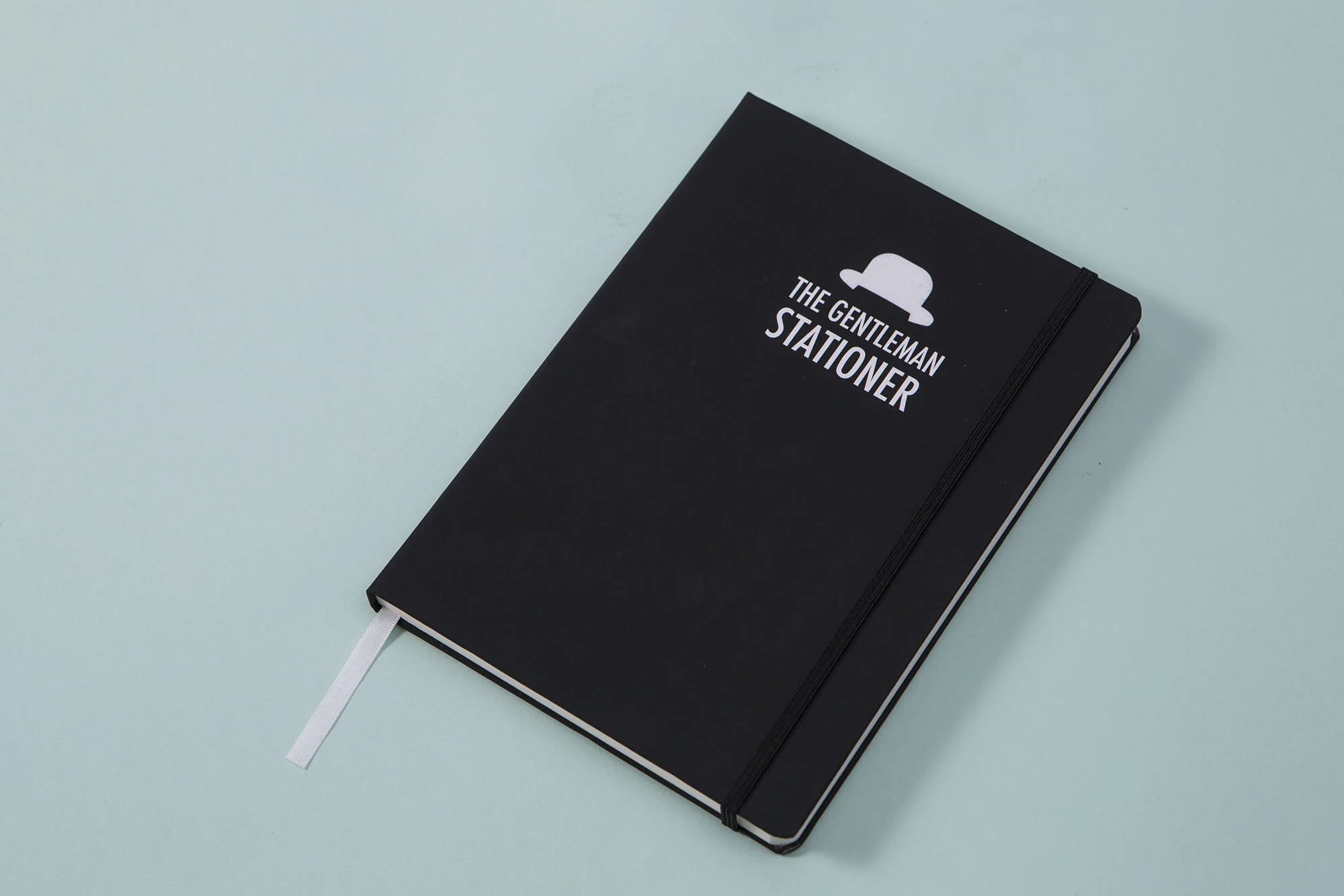
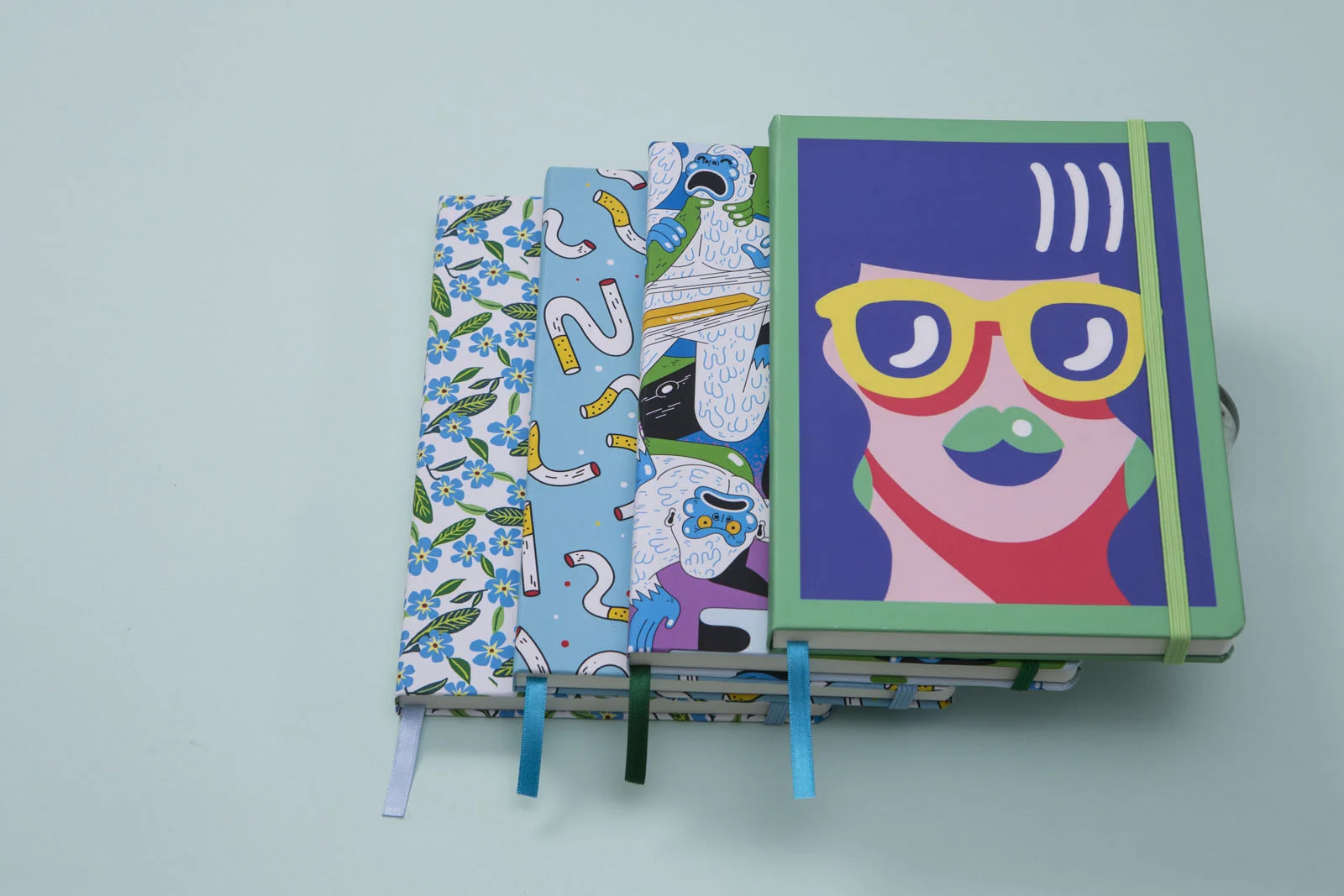
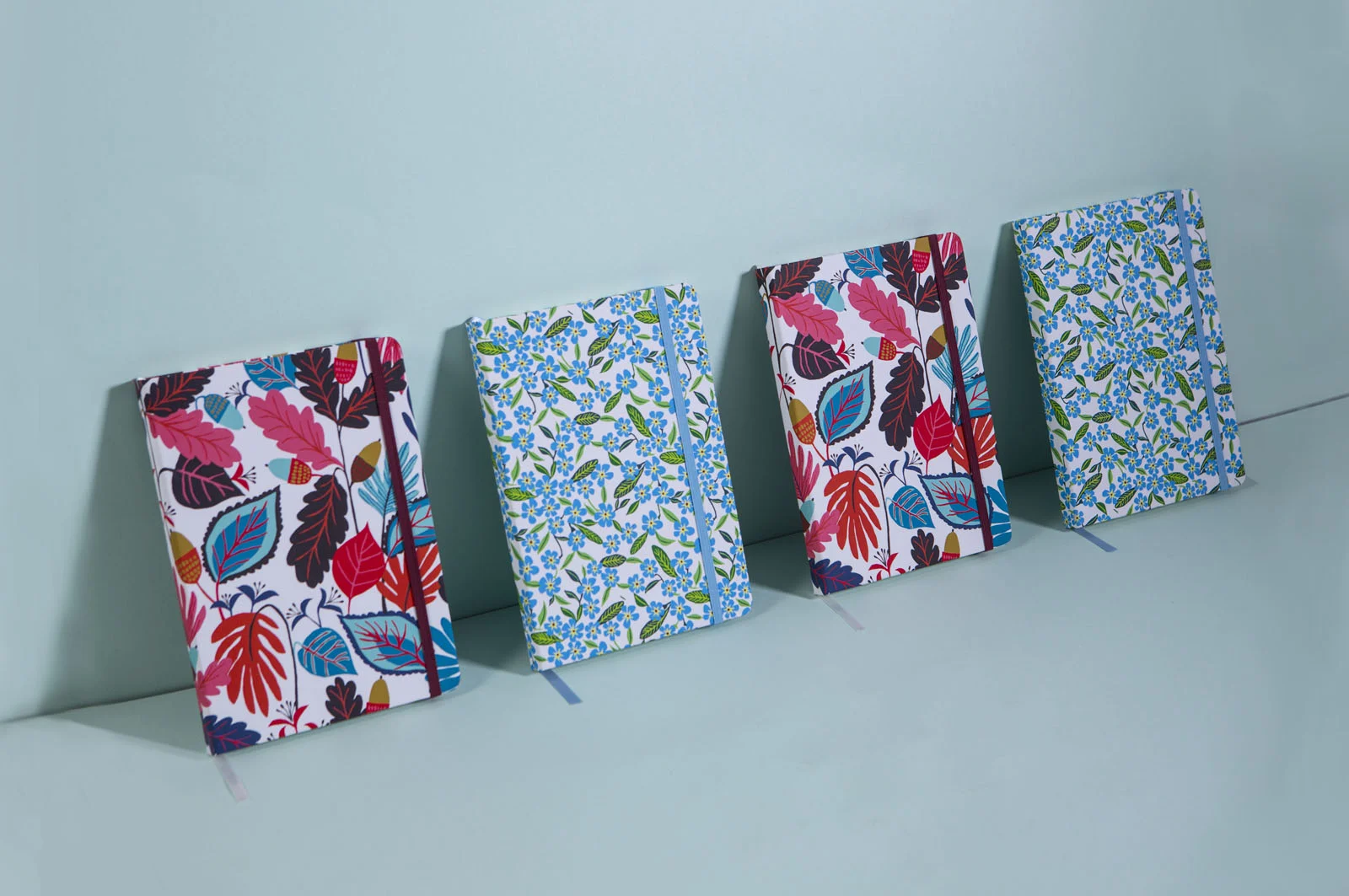
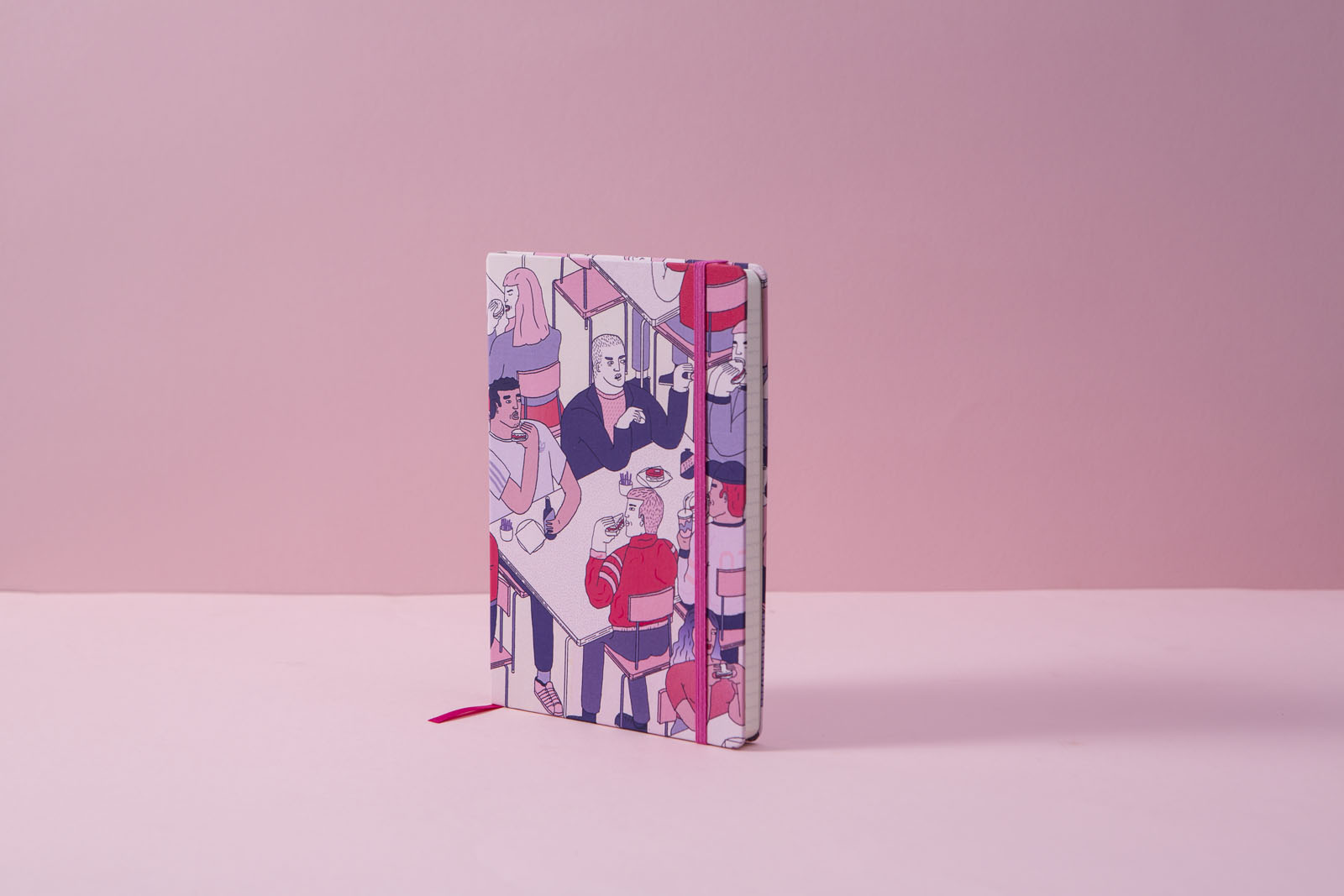
Book Block will print a design of your choice onto a Moleskine-style notebook, which you can customize with your choice of ribbon, paper, etc.  The printed cover is good quality--they print at 2400 dpi, and the result is much better than other "customized" Moleskine-style notebooks I've received at conferences, for work, etc.  They also offer custom debossed leather covers, an option that I would be interested in checking out in the future.  I can see how this could be a lot of fun--if not addictive--if you were a designer or artist with some very detailed, intricate designs that you want printed on a notebook.  I stuck with my blog logo for my test notebook.  Not the most original, but it came out well. These high-quality, professional images were provided by Book Block, along with my notebook.  I've also included some shots of other custom notebooks they have done, to give you a sense of what's possible.  

View fullsize BookBlock Custom Notebook6.jpg
View fullsize BookBlock Custom Notebook4.jpg
View fullsize BookBlock Custom Notebook5.jpg
View fullsize BookBlock Custom Notebook1.jpg
View fullsize BookBlock Custom Notebook2.jpg
View fullsize BookBlock Custom Notebook3.jpg

A Mini-Review of the Monsieur Notebook

The notebook I received is a customized Monsieur notebook, a brand that was heavily promoted a few years ago as a Moleskine-style notebook with a leather cover (either real leather or vegan leather). The notebook itself is very nice and sturdy, and lays flat.  The paper in my notebook is the 80 or 90 gsm plain paper, which is better than Moleskine paper but still has a lot of bleed and show-through with fountain pen and rollerball inks.  I wouldn't consider it unusable by any means, but this particular book will probably see more use with ballpoints, gel, and pencils.  If you decide to place an order with Book Block, and you write primarily with fountain pens, I would recommend that you upgrade to the 100 gsm "Fountain White" paper.  Also, YMMV with Monsieur's ruled or dot-grid paper, instead of the blank. Ana over at The Well-Appointed Desk had a good experience with Monsieur's stock 90 gsm ruled paper, which also comes in a dot grid format.  Monsieur Notebooks are more easily found in the U.K. than in the U.S., but you can order them through Amazon, with prices ranging from $15-25 depending on size and paper choice.    

View fullsize Monsieur Notebook Sample
View fullsize Reverse Monsieur Writing Sample

Takeaways

I'm very happy with my custom notebook, and once I burn through some of my notebook backlog, I'm considering ordering a few more in different cover designs (with the "fountain" paper).  I will be interested to see how well the cover on the notebook holds up.  The soft-cover feels very nice in the hand, but it does pick up finger marks and the spine creases fairly easily. That's likely due to the soft texture and the fact that I chose solid black, but I did want to mention it because people can be very particular about that sort of thing.  

A big thank you to Phoebe and her team over at Book Block, who worked with me on this notebook! 

DISCLAIMER:  Book Block provided me with a single notebook, free of charge, for review purposes.  My thoughts here are my own.  This post contains some affiliate links, through which I may be compensated a small amount if you purchase something from certain sites linked to in this article.  While I'd greatly appreciate it if you use these links to purchase an item you are interested in, you are, of course, under no obligation to do so.  Many thanks! 

In Notebook Review Tags Book Block, Custom Notebook, Monsieur Notebook
Comment

The Leuchtturm 1917 Notebook: my current "daily carry"

Leuchtturm 1917 A5 Notebook: The Fountain-Pen Friendly Basic Black Notebook

March 30, 2016

I always think of the Leuchtturm 1917 notebook as the fountain-pen friendly option for those who like the Moleskine aesthetic but hate Moleskine paper.  I have nothing against Moleskines per se, but I've found the paper so inconsistent that I even had one where I couldn't write on both sides of the page with a ballpoint pen, the show-through was so bad. 

The Leuchtturm 1917 A5 in basic black:  a similar aesthetic to the ubiquitous Moleskine, but the quality is much, much better. 

But paper quality issues aside, I admire Moleskine's simple, functional design, with the elastic closure, ribbon bookmark, back pocket, and relatively durable faux-black-leather cover.  Enter the Leuchtturm 1917 from Hamburg, Germany. This particular notebook that I've been using started life as a bullet journal, but I've since moved on from that system and I'm now using it as miscellaneous ideas/drafts/research notebook.  

The Leuchtturm 1917 also has the catchall "back pocket" folder.

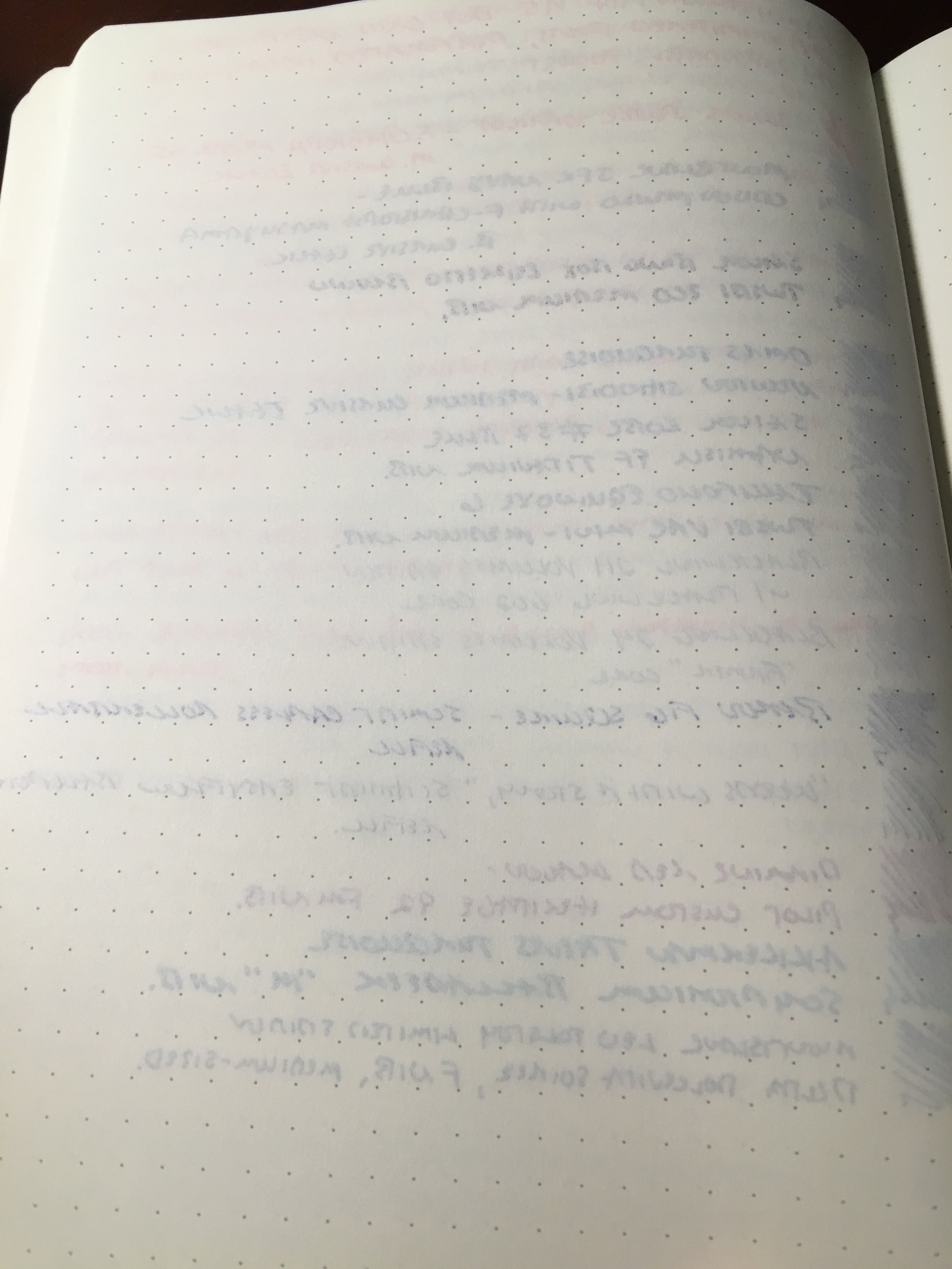
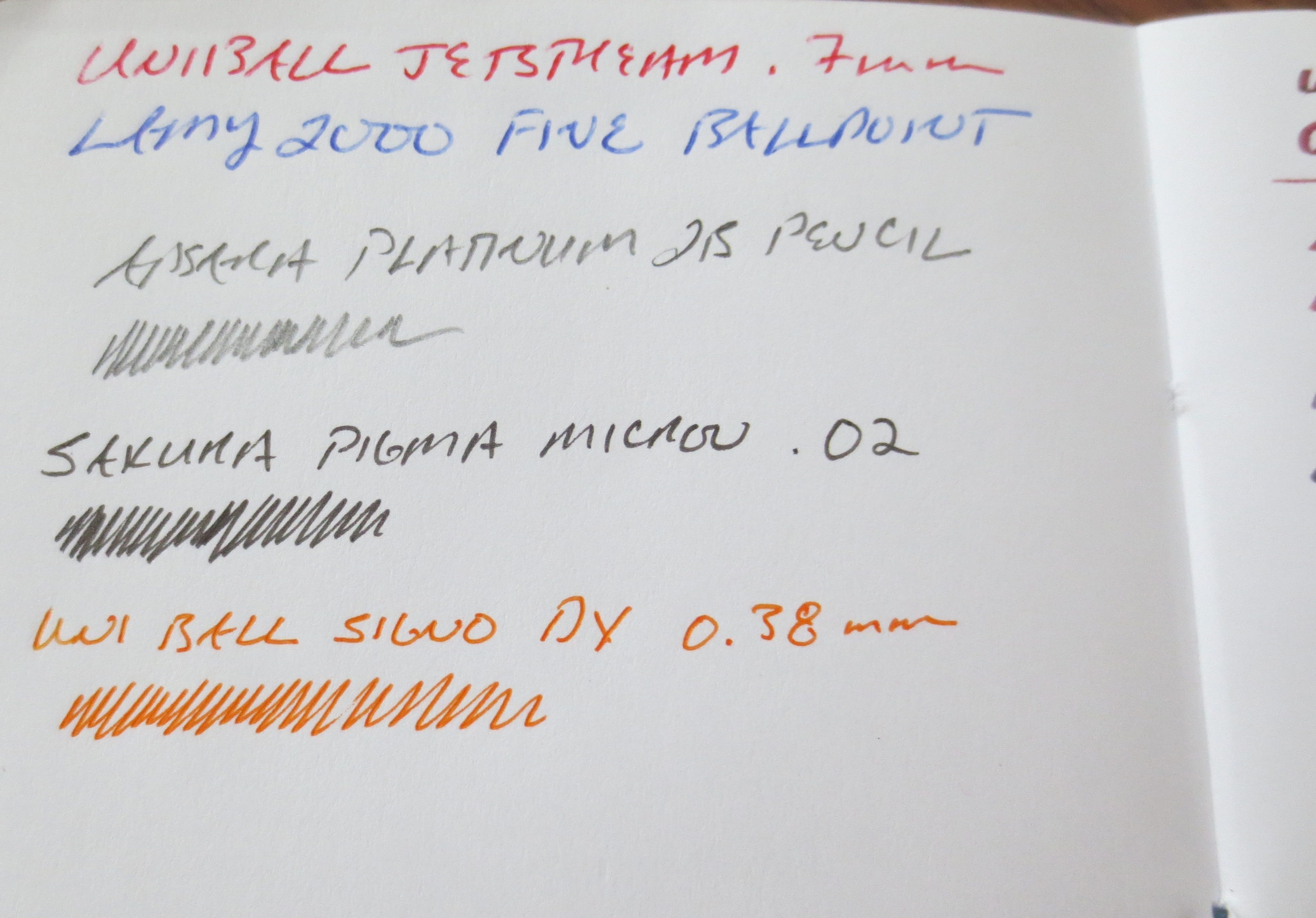
Overall, I've been very pleased with this notebook.  I'm currently about a quarter of the way through it.  This version has well-spaced dot-grid paper, which handles fountain pen ink better than a Baron Fig, but probably not quite as well as a Rhodia Webnotebook or a Quo Vadis Habana.  I did a pretty thorough test yesterday, and the only two pen-ink combinations that I used that had bleed or show-through (albeit minimal) were Sailor Bung Box Espresso Brown in my medium TWSBI Eco, and the Schmidt Capless .6mm Rollerball refill in my Baron Fig Squire.  Neither rendered the other side of the page unusable by any stretch.  

A dozen inks and pencils tested on a Leuchtturm 1917 A5 notebook, dot grid version.  

View fullsize Flip Side of Ink Samples
View fullsize IMG_0927.JPG

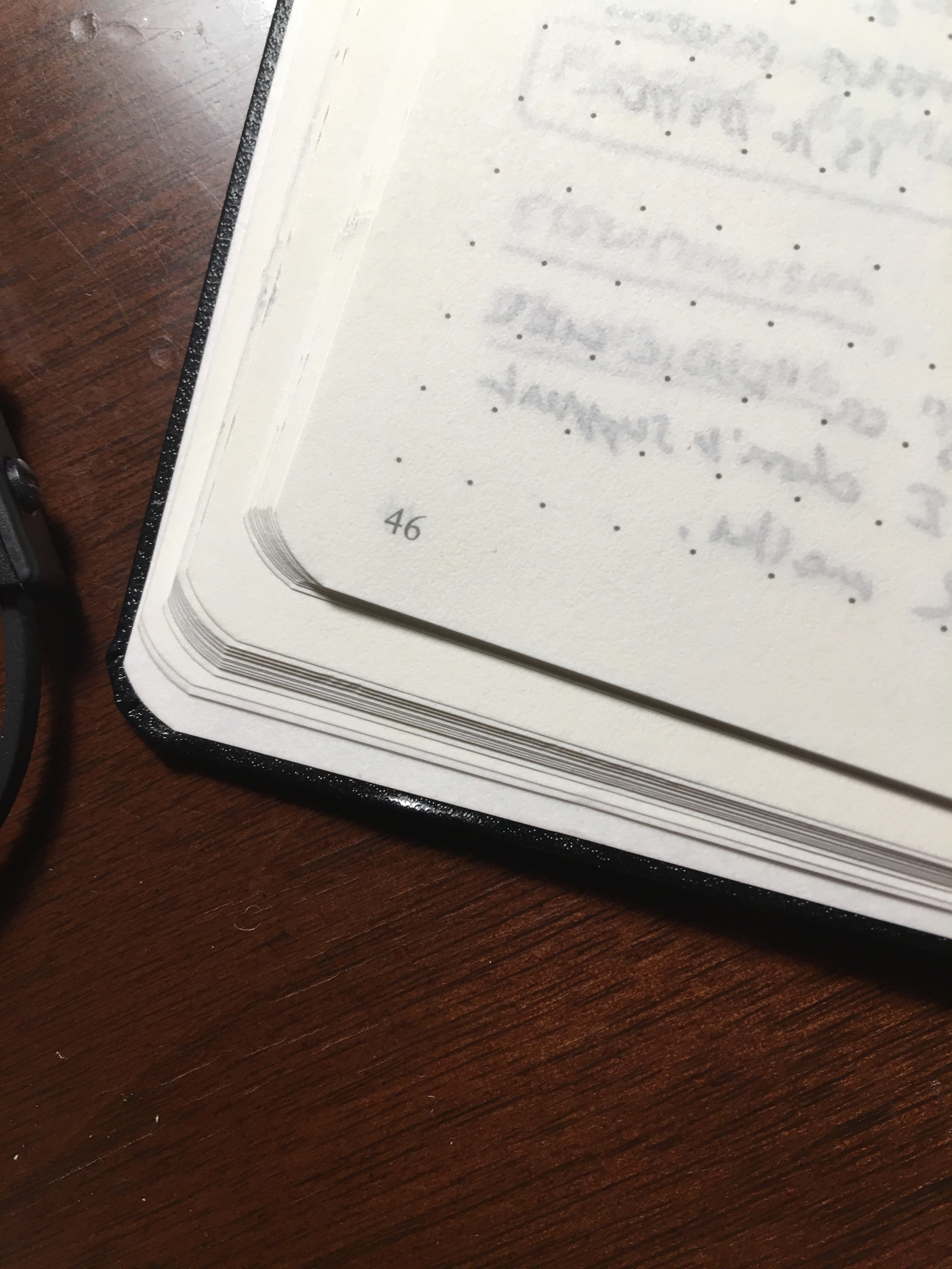
My favorite features are the 249 numbered pages and the built-in "table of contents," which make the Leuchtturm 1917 an easy notebook to index and an excellent option for those who work on multiple projects simultaneously and don't like to carry multiple notebooks. 

View fullsize Table of Contents
View fullsize Numbered Pages

Bottom line:  this notebook probably won't turn any heads, but as I mentioned, it's very functional and will stand up well to heavy daily use.  The version that I've reviewed here is the "classic black" A5, but Leuchtturm offers other colors and patterns as well.  Check out the various colors they offer here (though I have no idea how many of these options make it to the U.S.).

The Leuchtturm 1917 A5 Notebooks compare favorably to the Rhodia Webnotebook and the Quo Vadis Habana, both of which are also excellent and can be highly recommended because they feature Clairefontaine paper.  All of these notebooks are pricier than a Moleskine, but you are paying for quality, and plus, I haven't yet found Moleskine hardcover notebooks with dot grid paper as an option! 

DISCLAIMER:  This post contains affiliate links, through which I may be compensated a small amount if you purchase an item from any of the sites linked to in this article.  While I'd greatly appreciate it if you use these links to purchase something you are interested in, you are, of course, under no obligation to do so.  Many thanks!  

In Notebook Review Tags Leuchtturm 1917, Notebook, Notebook Review
5 Comments

The "Stamps" and "Brown Leaf" editions of the Backpocket Journal. 

Backpocket Journal by Curnow Bookbinding and Leatherwork

June 27, 2015

After reviewing my backlog of pocket notebooks, I opted for a product I have a small stash of but have never tried:  the Backpocket Journal by Curnow Bookbinding and Leatherwork. 

Vanness Pen Shop edition. 

At first glance, the Backpocket Journal doesn't break any new ground:  it's another pocket notebook similar to Field Notes, Word Notebooks, and the Baron Fig Apprentice (although Backpocket Journal predates the Apprentice).  Two things set Steve Curnow's products apart, however:  (1) the paper is much more fountain pen friendly than existing alternatives, and (2) the Backpocket Journal comes in custom covers and is hand bound with a sewn binding, which is both attractive and durable.  For those who insist on using fountain pens with their pocket notebooks, the paper is on par with the new Nock Co. dot-dash paper.  With non-fountain pens and pencils, I found that the Curnow paper was too smooth for my taste, but perhaps I've been spoiled by the super-tactile Baron Fig paper that I've grown to love.  

View fullsize IMG_1294.jpg
View fullsize IMG_1295.JPG
View fullsize IMG_1296.jpg
View fullsize IMG_1297.jpg

My writing samples show what happens when you try to push the limits of this paper with a fountain pen.  I used a TWSBI 580 with a  1.1mm stub nib, and also my stubbed Montblanc 146.  The standard Backpocket Journal paper easily keeps feathering under control, but there is slight bleed through, similar to what you would see using the same nibs on the Field Notes America the Beautiful or Shelterwood paper.  All other fountain pens performed beautifully.  Those who want to use flex or stub nibs in their pocket notebooks may want to spring for the Tomoe River paper edition.  

Pricing for the Backpocket Journal is consistent with the pocket notebook market in general:  $9 for a three-pack of the "standard" edition, and $10 for a three-pack of the custom cover editions.  The slightly more expensive Tomoe River Edition will run you $12.50, and comes with a lined guide to help keep your writing straight on the unlined Tomoe River paper.  Doug over at Modern Stationer has a great review of this product.  If I wasn't on a "new purchase" hiatus, I would order some of these immediately.  

The Backpocket Journal can be purchased directly from Curnow via their Facebook page or through the e-mail contact printed on the back of the notebook (how I purchased the "Brown Leaf" and "Stamp" Editions), or you can purchase the Vanness Edition used in the review from Vanness Pen Shop.  I received the Vanness version as a free sample when I purchased some ink at the Atlanta Pen Show (or maybe it was D.C., I lose track).   

In Notebook Review Tags Curnow, Backpocket Journal, Pocket Notebook
Comment
← Newer Posts Older Posts →
Store Hours and Events
Shop T.G.S. Online
Updated 2026 "Best Pens" Guide
No results found
On The Paper Trail: Live In Nashville Event Tickets Now Available!
TGS_25 Roterfaden Restock Notification
Hierarchies of Fountain Pen Friendly Paper

Join Our Patreon!
Subscribe to the TGS E-mail List

Featured Posts

Featured
Everyday-Stationery-Bags
July 25, 2026
What's the Best Everyday Stationery Bag? My Own Considerations and 5 Options for Pen Show Season
July 25, 2026
Read more →
July 25, 2026
Graphilo-Kobeha-Paper.jpg
July 11, 2026
Paper Review: Graphilo by Kobeha
July 11, 2026
Read more →
July 11, 2026
Pilot-Custom-Heritage-92.jpg
June 6, 2026
Workhorse Pens: Pilot Custom Heritage 92 Fountain Pen
June 6, 2026
Read more →
June 6, 2026
The Gentleman Stationer RSS

View Cart

© Digital Divide Media, LLC, 2014-present.

All content is the exclusive property of Digital Divide Media, LLC, d/b/a The Gentleman Stationer, including “The Gentleman Stationer” website and trademark, and should not be reproduced without express written permission.  All rights reserved.

All content containing paid advertising, affiliate links, or sponsored content will be plainly disclosed by a disclaimer when/if featured.

Contact Information

Website Terms and Conditions

Store Shipping Policy and Return Policy

Privacy Policy and Cookie Policy

Accessibility Statement

Powered by Squarespace