• Blog
  • Shop
  • Podcast
  • Resources
  • About
  • Archive
  • Contact
  • Cart
  • Sign In My Account
Menu

The Gentleman Stationer

Vintage Living in the Modern World.
  • Blog
  • Shop
  • Podcast
  • Resources
  • About
  • Archive
  • Contact
  • Cart
  • Sign In My Account

Back to Hobonichi: My Daily Journaling Setup for 2024

January 3, 2024

I spent a lot of time over the past four months thinking about how I wanted to approach journaling in 2024. Over the past year, I definitely became more consistent in terms of how often I sit down to write (always by hand, never on the computer), but until my work sabbatical in October didn’t spend much time thinking through a coherent journaling strategy and how I wanted to use journaling to support my personal and professional goals. After some experimentation, I decided to divide my journaling between three different books: (1) a professional “journal” that I use to track how I spent my time each day, mainly on work and more structured personal projects; (2) a “observations” journal that’s in a smaller format I can carry with me; and (3) a more traditional “reflections” journal that I write in each morning.

*Note: I don’t use a traditional paper “planner” (i.e., a calendar to track dates and appointments) for professional reasons. My schedule is too complex and deadline-dependent to rely on manual updates and edits, especially since due dates and meetings constantly change (often without my knowledge). I mention this up front because I know that I’m going to get the question: why does someone need three planners? The answer is that even though the Hobonichi Techo - and other similar “planners” such as those from Stalogy and the Midori Codex - are marketed as traditional calendar/diaries, the layouts are extremely flexible and can easily be used as journals or dated notebooks, which is how I’ve always viewed them.

Journal No. 1: Hobonichi Cousin A5

My primary everyday professional notebook/journal is going to be the Hobonichi Cousin A5. For the last quarter of 2023, I experimented with “time blocking” as part of an effort to improve my concentration and focus, which is a time-management technique that can be helpful for those of us who work more than one job and/or whose profession involves managing multiple complex projects. A full discussion of this technique (and how I’ve adapted it to my needs) is beyond the scope of this simple blog post, but the general idea is that you sit down each morning for 15-20 minutes and plan out your day in blocks of time dedicated to a specific task or project, to the exclusion of anything else that may distract you. You intersperse your day with “admin” blocks to keep up with more routine things such as e-mail, phone calls, paying bills, etc. It might seem rigid at first, but two things happen: (1) the “a time and place for everything” philosophy underlying the structure creates space for better concentration, and eventually you’re more easily able to resist things such as checking e-mail that pull you out of the work your doing because you know you’ve set aside time for them later; and (2) you’re able to finish tasks quicker because you’re giving yourself the space to concentrate on a single thing rather than multi-tasking.

Yes, the Cousin fits in the Roterfaden, but you will need to embrace the “one notebook” Roterfaden strategy (unless you go with the Cousin Avec).

For those interested in learning more, I’d recommend picking up a copy of the “Time Block Planner” (the most recent version of which contains decent paper). I found that the layout didn’t work perfectly for me - I think it’s actually intended more as a “workbook” to help you learn the technique for the first time - but the experience of working through the planner for eight weeks or so was invaluable.

A sample time block plan. Obviously I had to redact details.

I draw my time blocks on the left-hand side of the Hobonichi Techo, and use the remainder of the daily page for my “catch-all” notes and administrative task lists. If you’re in the middle of a time block and an unrelated thought/task/observation pops into your head, you jot it down in the free space on your planner or notebook. In addition to being useful for organizing my work and thoughts, I enjoy having a fairly detailed record of exactly how I spend my time. The page layout of the Hobonichi Cousin A5 is well-suited to how I time-block.

I use the monthly calendar as a way to experiment with content plans. (Most of this is a draft which then gets imported into my computer as I decide what I’m going to publish/write about.)

I currently have the Hobonichi Cousin in my A5 Roterfaden binder. Because the Cousin is a thick notebook, I attached it to the Roterfaden using the center clip, use the front clip as a bookmark for the “weekly” view, and plan to use the third clip to hold loose papers, etc. (For those who are interested, we currently have A6 Roterfadens in stock with another shipment of A4 and A5 binders on the way from Germany as we speak.)

On Sunday afternoon I try to sketch out a “weekly time block plan” which is intended to be rough. I then flesh it out either in the morning before the workday starts or the night before.

Journal No. 2: Hobonichi Weeks Mega

Less a journal and more of an “observations” notebook without any strict format requirements. This year I’m making a conscious effort to be more present, to read more, and generally to engage in activities that necessarily require a longer attention span, such as tackling more difficult books and watching longer films. I constantly collect book and movie recommendations, and always maintain a running annual list of books read/movies watched for the year, which is probably how I will use the blank pages at the back of the Weeks. I also enjoy having a “week on a page” layout, which I’ve used so far to jot down just one or two memorable things I did/observed on each day. My Hobonichi Weeks had a start date of November 27, 2023, so I already have about six weeks under my belt.

Journal No. 3: Hobonichi A6

Finally, my third journal is my reflections journal. I’ve managed to keep up my morning journaling routine to the point where I reliably write most mornings, reflecting on the prior day. For this journal I chose the standard Hobonichi A6, which contains just enough space to allow me to write a meaningful entry in 30 minutes or less.

I don’t have a cover for this third journal yet. As discussed below, I’m waiting for a new shipment of Roterfaden Taschenbegleiter covers, so I may choose an A6 size for this one, but since this journal typically stays on my desk at home the best choice might be a slimmer Gfeller undyed leather cover or one of the Galen Leather “Crazy Horse” varieties.

Stay tuned, because throughout the year, I plan to share more about both journaling strategies and my likes/dislikes of the various Hobonichi editions. Currently, they’re all pretty much exactly what I was suspecting, with no surprises other than how effortless it’s been to enjoy them. Happy New Year, everyone!

The Gentleman Stationer is supported entirely by purchases from the T.G.S. Curated Shop and pledges via the T.G.S. Patreon Program. You can read more about T.G.S. Patreon in yesterday’s post.
In Editorial, Notebook Review, Hobonichi, Journaling Tags Journaling, Notebooks, Editorial
3 Comments

Travel Chronicles: Actually Traveling with a "Traveler's Notebook"

October 28, 2023

As befits its name, the Traveler’s Notebook makes a fabulous traveling companion, or so I’ve found on more than one occasion over the past month. Since I’m on the road for a brief long-weekend trip before a hectic week that includes Fountain Pen Day and my eventual return to the office, I thought it might be fun to take a look at the specific setup that I’m using in my personal Traveler’s Notebook, namely the accessories.

Accessories - Folders, Cases, and Card Holders for the Road

For me, the accessories are the most important items for a “travel” rig since they transform the Traveler’s Notebook from a “notebook” to a functional travel portfolio/wallet. I’m currently outside the U.S., so I need to carry more documentation that I typically would on a domestic flight, including a passport, customs documents, cash, etc., as well as multiple credit cards, identification, and paper copies of my itinerary and confirmations. Here are the various accessories currently in my Traveler’s Notebook:

  • Zippered PVC Case. While I always use the clear PVC zippered case to hold things like stamps, paper clips, and Book Darts, this weekend I used it to carry my Passport and customs receipts while moving through the airport. It’s a convenient - yet relatively secure - way for me to keep these documents handy. (I wouldn’t recommend storing these documents in your notebook when you’re not actively using them. Keep them in the hotel safe or concealed on your person!)

  • Traveler’s Notebook Pocket Stickers. Like the PVC Zippered pouch above and the folder discussed below, you can add pockets to the front and back covers of your Traveler’s notebook to hold printed copies of confirmations and itineraries, cards, and more. They aren’t necessary for the particular cover I’m using on this trip (more on that below), but I have them in both of my Standard leather covers.

  • Traveler’s Notebook Sticky Notes. I’m a sticky note addict who is never without a healthy supply of them. I make “side notes” to myself when I’m journaling, annotate books that I’m reading, and most importantly, leave last-minute notes to the dogsitter while I’m running out the door late for my flight. Though I might not use them regularly when I travel, I can’t bring myself to leave them at home.

  • 2024 Limited Edition Plastic Folders and Pencil Boards. I didn’t realize how useful pencil boards (and journaling stencils in general) were until I began using one of my Atelier Musubi notebooks as my personal journal. Not only does it allow you to change up the ruling as you work your way through a blank notebook, but here it helps in situations where you don’t have a sturdy, level writing surface, especially for a fountain pen. A pencil board can also “firm up” the softer Traveler’s Notebook cover, creating a better platform for writing while standing.

  • Brass Binder Clip. Whenever I’m writing on the go, and especially when I sometimes have to write standing up, on an airline seatback tray table, or other cramped space, I rely on the Traveler’s Company Brass Binder clip to help hold the notebook open, to mark my place in a specific refill, and even to just clip papers together. This clip is actually one of my most-used stationery accessories across the board, as I switch it between different systems and also carry it in my Roterfadens and Plotters.

You can read more on my personal Traveler’s Notebook Setups here, and if you’d like a tutorial on how to install and connect different refills in the Traveler’s Notebook covers, I’ve also done posts on that in the past.

My favorite notebook cover ever. No I won’t part with it.

For those Who Ask, No, That’s Not an Official Traveler’s Notebook Cover and This One is Unfortunately Unobtainium, Though I Hope That Changes.

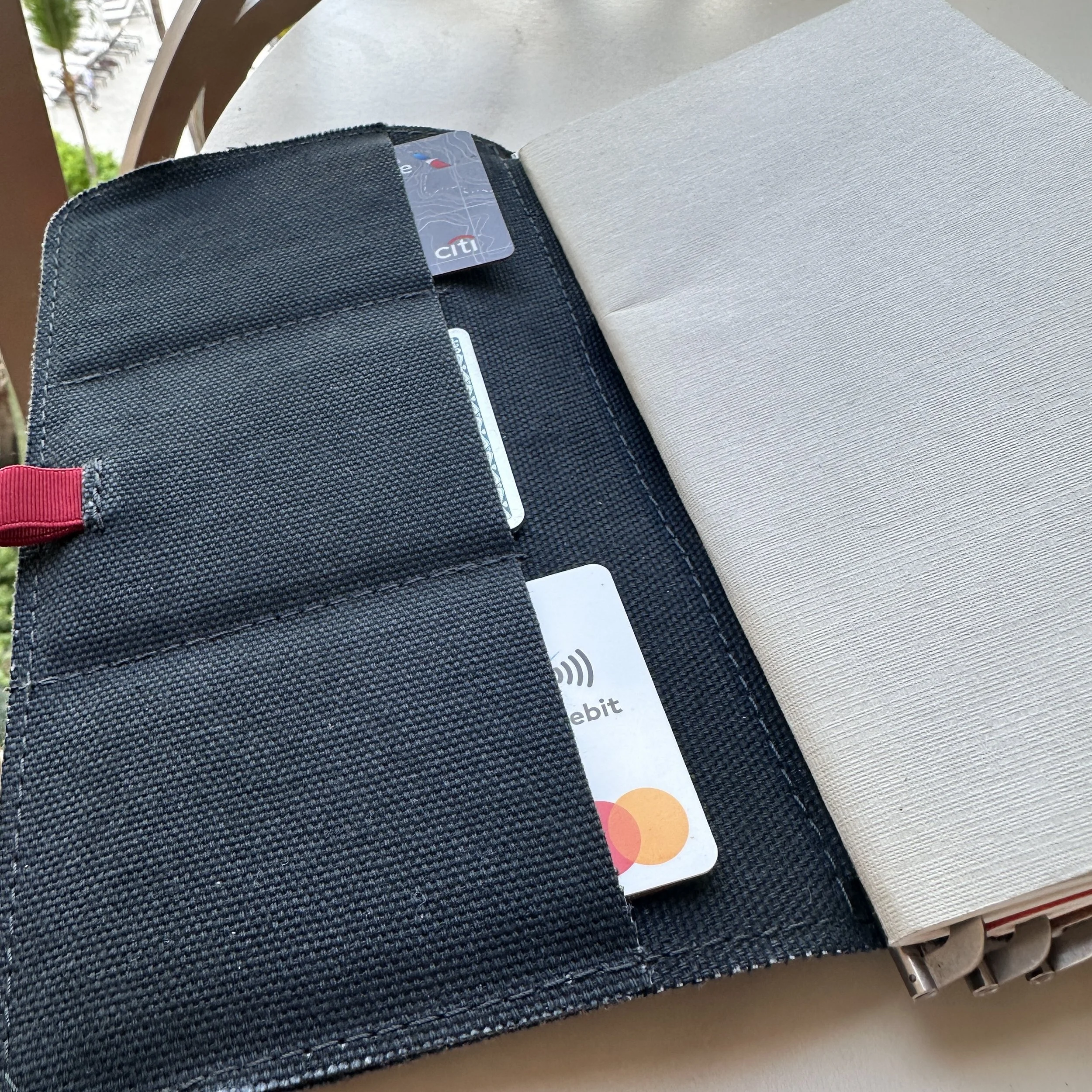
It’s actually an older Roterfaden model cut in an A5 slim size, which is no longer made. I love it because it easily fits Traveler’s Company and other similarly sized refills, and I’m hoping that Roterfaden will agree to bring it back. You can, of course, clip Traveler’s Company refills and accessories into the regular A5 Roterfaden covers, and you can take advantage of their stitched-in card pockets for credits cards and IDs.

This is a very short trip, as I’ll be back Monday, so no delays to regular content, etc. Maybe I’ll do one-more travel-related post on my return?

It’s a toss-up for me whether the PVC Zippered Pouch or the Brass Clip is the more overall useful stationery accessory.

Stitched Canvas Card Slots

The canvas slots on the inside cover of this particular Roterfaden transform this cover into an excellent oversized travel wallet.

The Gentleman Stationer is supported entirely by purchases from the T.G.S. Curated Shop and pledges via the T.G.S. Patreon Program. The Gentleman Stationer is also an authorized retailer of both Traveler’s Company and Roterfaden products.

In Notebook Review, Travel Tags Traveler's Notebook, Traveler's Company, Roterfaden, Pen Travel
2 Comments

Building the Perfect Notebook for Brainstorming: Quirky Refills and Erasable Pens

June 28, 2023

I think I’ve permanently given up on notebook minimalism. While I have a core set of 3-4 notebooks that I use on a daily basis and take with me pretty much anywhere I go, I also have a “healthy” stockpile of special-purpose notebooks that I pull out periodically - some more often than others - to help me with various tasks and to hold information relating to specific projects that don’t require daily attention.

The “Mandala 9x9” layout. You start with a central goal or idea, with eight key inputs, which you can then break out into their own box.

One such notebook is what I’ll refer to as my “brainstorming” notebook, which I use when I want to work through ideas for a project, piece of writing, or simply to hash out a problem I’ve been dealing with, personal or professional. I’ve used many different notebooks for brainstorming over the years, with different rulings ranging from blank to dot grid to meeting, but what about something more structured?

The “Concentric” Layout from the Laconic Think Refill. I’ve honestly not figured out how I want to use this one yet.

I discovered the Laconic Style system at NY Now back in January. To me, the beauty of this particular notebook system is the combination of a formal structure and customization. Laconic has blank notebooks, standard diary/planner refills in daily, weekly, and monthly formats, as well as special purpose notebooks that you can use to build out your system. Two specific refills that I’ve recently used from this latter category include “Think” and “Spreadsheet” layouts that I’ve not previously seen elsewhere. The “Think” refill features four different templates (16 pages for each pattern): a “Mandala Chart 9x9”, a “Coordinate Axis” layout (for your classic “SWAT” analysis), a “Concentric Chart,” and a “4 Panels” Memo (consistent with what you might use to plan slides or storyboards). While I’m not an expert on how to use these various layouts other than having some experience with the 4-panel storyboard, the common theme seems to be that the different designs allow you to visually link your ideas together as you go. I’ve long been a flow-charts and mind-maps on blank paper type of guy, but lately a bit of structure has been helpful to mix things up.

The 4-Panel/Storyboard Layout from the Think Notebook

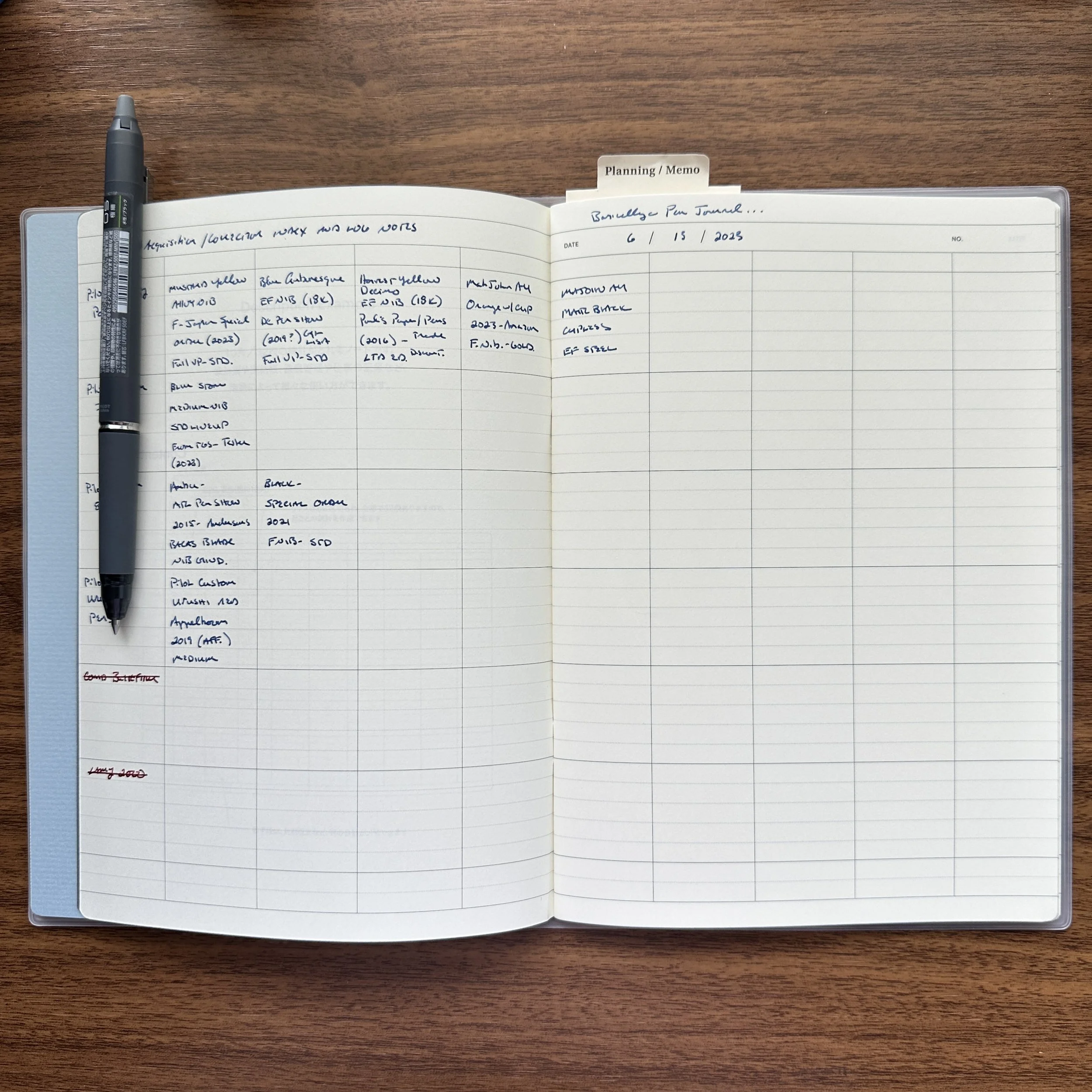
The second refill I’ve been using is the “Spreadsheet” refill. It’s exactly as described: a notebook full of spreadsheet cells that serve multiple purposes: to organize notes on my personal pen collection, such as where I purchased each piece, price paid, etc.; as a content calendar (which is something I’ve tried very hard to stick to, with limited success even though it would make my life infinitely easier); and as a ledger for running down monthly finances and tracking invoices.

The start of my “Spreadsheet” Pen Journal!

Takeaways and Where to Buy

I’ve enjoyed using the Laconic notebooks (as well as the add-on accessories like the bookmarks), and have mainly been using them with Pilot Frixion gel pens in the .4mm and .5mm tip sizes. While I would compare the Laconic paper to something like that featured in the Kokuyo Jibun Techo Planner (i.e., it works perfectly well with low-maintenance fountain pen inks in a fine or extra-fine nib), these erasable gel pens lend themselves quite well to writing in planners and charts, given that you may want to (1) write very small in the way that a micro-tipped gel pen can do; and (2) erase and change information that you may be “logging.” You can purchase the .5mm Frixion pens at most big box (or even grocery) stores, and there are plenty of online retailers, including Jetpens or Amazon, that sell the .4mm needle-tip versions. The ink has come a long way in terms of legibility, and I’ve found the pens to work as advertised.

The “Coordinate” Layout from the “Think” Journal with the Pilot Frixion. The ruling is pretty small on these notebooks, so for filling out charts, etc. I’ve used either a super-extra-fine fountain pen with Pilot Blue-Black ink (which holds a fine line quite well) or the Pilot Frixion gel pen.

As mentioned above, the notebooks shown here are from Laconic Tokyo, one of the brands we carry directly in our shop. While I’ve been carrying these two inserts around in the Laconic Style cover, I’m thinking of building out a larger brainstorming notebook using a higher-capacity option. The A5-sized refills are compatible with most A5 covers, including the Midori MD covers, and multiple-notebook covers and cases such as the Lochby Field Journal and Roterfaden Taschenbegleiter.

The Gentleman Stationer is supported by purchases from the T.G.S. Curated Shop and pledges via the T.G.S. Patreon Program. This post does not contain paid advertising or affiliate links.

In Notebook Review Tags Laconic, Pilot Frixion, Notebook Systems, Paper Review
2 Comments
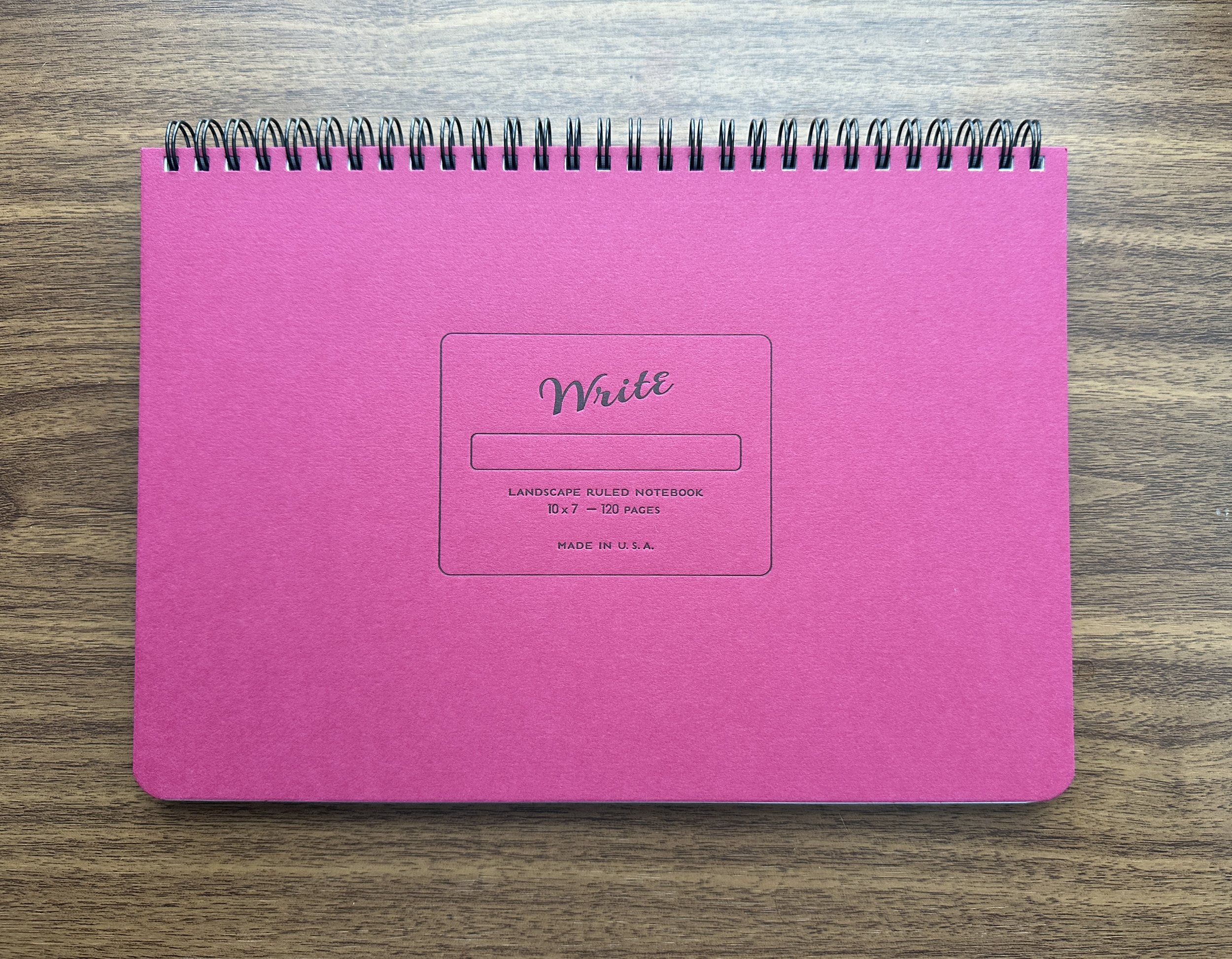
Write Notepads Landscape Notebook in Plum

Paper Review: The Write Notepads Landscape Notebook As a Drafting Workhorse

June 7, 2023

The response to last month's review of the Cortex Brand Sidekick Notepad was overwhelmingly positive - there's apparently much interest in this sort of practical “workhorse” stationery product - so I thought it might make sense to dive further into the landscape notebook/desk pad category. Today I'll be discussing the Write Notepads Landscape Notebook, a long-time favorite of mine which plays a similar, yet distinct, role in my personal workflow.

Baltimore, Maryland-based Write Notepads is an independent print shop that makes a full line of spiral notebooks, writing pads, and pocket notebooks in both standard and limited editions. Back in 2020, when I launched the shop, they were one of the first to believe in my idea enough to allow me to carry their products, for which I'm grateful. The main reason I continue to carry the brand, however, is their commitment to quality, and maybe a little bit of ensuring that I personally have ongoing access to certain of the items in their lineup. (Disclaimer: As mentioned, we sell certain of the Write Notepads products directly in our shop. I don't think this affects my opinion of what has long been regarded as a good standard notebook by the community at large, but transparency is important.)

Write Notepads spiral notebooks all feature a fairly durable kraft paper cover and a thick chipboard backing, bound together with a durable double spiral binding.

I enjoyed reviewing the Sidekick Notepad, and the more structured layout of that pad has found its place in my workflow. Certain types of writing that I do, however, requires unformatted paper, and I can burn through a LOT of it quickly. Take yesterday, for example. I spent much of the day on Zoom calls and/or reviewing e-mails in order to collect input from a dozen different people on a project, while simultaneously processing my thoughts into a longer-form outline that will eventually make it's way into a 50-page memorandum. Since I almost always do my first draft of anything by hand, I had a landscape-style notebook (the one pictured here) beneath my keyboard and essentially took notes in "draft" form as I went back and forth in conversation. By the end of the day I had filled four or five pages, with more looseleaf notes taken on a Baron Fig Mastermind pad.

Obviously I can’t show you the actual writing I do in my day job, but it’s nice to be able to write a continuous line horizontally across the page in this format.

Why this personal anecdote? To illustrate why and how I take use case into context whenever I discuss a product, offer a recommendation, and/or make choices for my own setup. For example, in my review of the Sidekick, I noted that it might not be a cost-effective option for "those who burn through 5+ sheets of paper on a daily basis, or who only use desk pads for taking lots of notes and drafting documents." Essentially I was talking about myself and a subset of the T.G.S. readership that I know maintain similar working habits. While none of the paper I use is inexpensive, in order to afford my preferences I do try to keep an eye on the overall cost of the paper I use for certain specific writing-intensive projects, and lately I've even tried to move some of my longhand work to an e-ink tablet (more on that later).

I’ve had very good luck using Write Notepads paper successfully with broad nibs and stubs, even combined with very wet inks.

Given the type of writing that I do, Write Notepads is one of several brands that strikes a balance between paper quality and cost. The paper works well with fountain pens, and is absorbent enough to dry relatively quickly when I'm writing quick notes at work and need to flip the page. The sturdy chipboard covers hold up in a bag, and will last a long time in storage if I need to maintain work notes long-term. Are these notebooks perfect? No. For one thing, I REALLY wish the pages were perforated, and I'd probably be willing to pay a few bucks extra per notebook for that feature. The Landscape Notebook would - in my opinion - be perfectly sized if it were a half-inch shorter to allow for a better fit beneath the keyboard. But no "perfect" product exists - this hobby wouldn't be fun if it did, right? - and that's why I'll likely already have a rotating stable of different pens, pads, and notebooks to collectively get me through my work week.

Despite the absorbency, there is no bleedthrough and very little, if any, show-through on the paper.

Takeaways and Where to Buy

Certain products are great because they're just solid, well-executed examples of what they are, and while not inexpensive, cost-effective enough to allow you to use them in larger quantities without feeling too guilty or extravagant. I've long loved the vintage aesthetic of the Write Notepads spiral notebooks, and whether I'm working with fountain pen, ballpoint, or pencil, the paper remains a staple of my workday.

Color selection continues to expand. Arctic Blue is my personal favorite, followed by Pistachio.

We sell most of the entire Write Notepads lineup directly, via our online shop, at pen shows we visit, and for local pickup in the greater Nashville, Tennessee area. The Landscape Notebook is priced at $20 for a 120-page notebook (writing front and back) and available in several different colors, including Black, Pistachio, Plum, Arctic Blue, and Forest. (While technically sold only in a lined ruling, if you prefer dot grid paper, you can achieve the same landscape effect by taking a Write Notepads Dot Grid Spiral Notebook and turning it sideways.) Those who prefer more structure to the notebook they have sitting under their keyboard may want to look at the Weekly Planner layout, which also features the spiral binding on the side, not the top.

Further Reading

If you're interested in reading more on landscape-style notepads, my other two favorite options include the Cortex Brand Sidekick Notepad (recently reviewed and discussed above), and the Baron Fig Mastermind, which might be the most inexpensive option in my everyday paper arsenal and a top choice for everyday "scratch paper".

The Gentleman Stationer is supported entirely by purchases from the T.G.S. Curated Shop and pledges via the T.G.S. Patreon Program. This post does not contain paid advertising or affiliate links.

In Notebook Review Tags Write Notepads, Paper, Paper Review
1 Comment

Introducing Nakabayashi Logical Prime Paper: Ink Friendly and Quick Drying

May 13, 2023

Earlier this year, my friend Ana over at the Well-Appointed Desk recommended that I try out Logical Prime paper from Nakabayashi Stationery, a brand I knew by reputation (mainly for their scissors and desk accessories) but had never personally tried. This paper is apparently known for being fountain pen friendly, with relatively short dry times and nice sheening and shading for showcasing ink.

So far, the quality has impressed. I’ve pushed this paper with some fairly wet nibs - including a No. 8 Bock Titanium nib - and tested multiple inks, and the only one that’s feathered or bled has been a Kakimori pigmented ink that, frankly, has feathered and bled through everything I’ve tried except mixed media paper. I can see this Logical Prime paper working its way into my rotation, especially where I need a slimmer spiral notebook for discrete projects.

The notebooks come in four rulings and a blank option. Clockwise from top left: 7mm “lined”, 6mm “lined”, grid, and dot.

The Logical Prime Notebooks contain 40 sheets (80 pages) in the thread-bound format, and 50 sheets (100 pages) in the “W-Ring” spiral binding. The paper comes in four different rulings, including some interesting 6mm and 7mm lined variants that remind me of Clairefontaine Séyes-ruled paper. Pages have a header reminiscent of that on Maruman Mnemosyne, allowing you to better organize your notes.

All of the standard fountain pen inks I tested worked extremely well.

Takeaways and Where to Buy

Nakabayashi Logical Prime paper recently became more widely available in the U.S. So far, testing with this paper has been extremely positive, and I’ve listed an initial shipment for sale in the shop in both the “Thread Binding” and “W-Ring” (spiral bound) formats. These notebooks are relatively inexpensive, with the thread-bound version priced at $6 and the W-Ring version priced at $7.50. Note that the Logical Prime paper is considered Nakabayashi’s premium paper option, with certain other Nakabayashi paper not handling fountain pens quite as well. I don’t plan to stock anything other than Logical Prime until I have had a chance to test their other offerings.

This post does not contain third-party affiliate links or paid advertising. The Gentleman Stationer is supported by purchases through the T.G.S. Curated Shop and pledges via the T.G.S. Patreon Program.

In Notebook Review, Paper Products Tags Fountain Pen Friendly Paper, Paper Review, Nakabayashi, Nakabayashi Logical Prime
Comment
← Newer Posts Older Posts →
Store Hours and Events
Shop T.G.S. Online
Updated 2026 "Best Pens" Guide
No results found
On The Paper Trail: Live In Nashville Event Tickets Now Available!
TGS_25 Roterfaden Restock Notification
Hierarchies of Fountain Pen Friendly Paper

Join Our Patreon!
Subscribe to the TGS E-mail List

Featured Posts

Featured
Everyday-Stationery-Bags
July 25, 2026
What's the Best Everyday Stationery Bag? My Own Considerations and 5 Options for Pen Show Season
July 25, 2026
Read more →
July 25, 2026
Graphilo-Kobeha-Paper.jpg
July 11, 2026
Paper Review: Graphilo by Kobeha
July 11, 2026
Read more →
July 11, 2026
Pilot-Custom-Heritage-92.jpg
June 6, 2026
Workhorse Pens: Pilot Custom Heritage 92 Fountain Pen
June 6, 2026
Read more →
June 6, 2026
The Gentleman Stationer RSS

View Cart

© Digital Divide Media, LLC, 2014-present.

All content is the exclusive property of Digital Divide Media, LLC, d/b/a The Gentleman Stationer, including “The Gentleman Stationer” website and trademark, and should not be reproduced without express written permission.  All rights reserved.

All content containing paid advertising, affiliate links, or sponsored content will be plainly disclosed by a disclaimer when/if featured.

Contact Information

Website Terms and Conditions

Store Shipping Policy and Return Policy

Privacy Policy and Cookie Policy

Accessibility Statement

Powered by Squarespace